
Cysteine (Cys) residues in proteins and peptides are capable of forming disulfide bonds (i.e., disulfide bridges), a reversible covalent linkage between two side chain thiol groups. Disulfide bonds confer conformational constraints in linear peptide sequences that molecular rigidity and more stable secondary structures. Disulfide rich peptides are less prone to enzymatic degradation and can sometimes increase binding affinity to the corresponding receptor.
Conformationally stable disulfide-rich peptides have lead to many selective and potent classes of peptides. Toxin peptides from scorpions (e.g., chlorotoxin), cone snails (e.g., conotoxins), snakes, and spiders as well as host-defense peptides (e.g., α-defensins and β-defensins are important classes with diverse pharmacological applications. Conotoxin and chlorotoxin are potent blockers of ion channels and have been indicated as treatments for chronic pain and cancer.
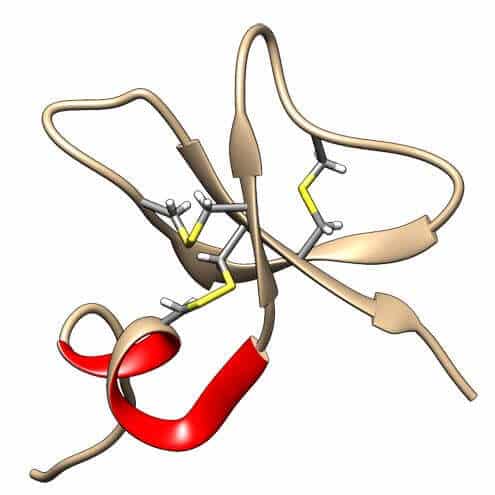
β-Defensin-3, human
(DEFS-005)
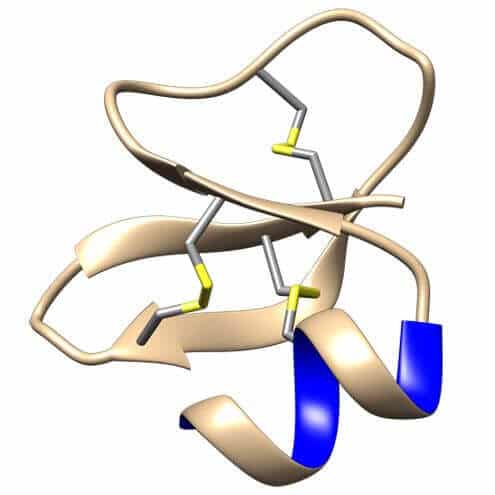
β-Defensin-1, human
(DEFS-003)
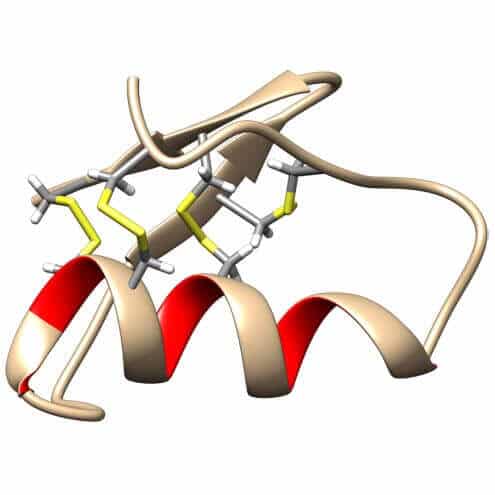
Chlorotoxin
(CLTX-001)
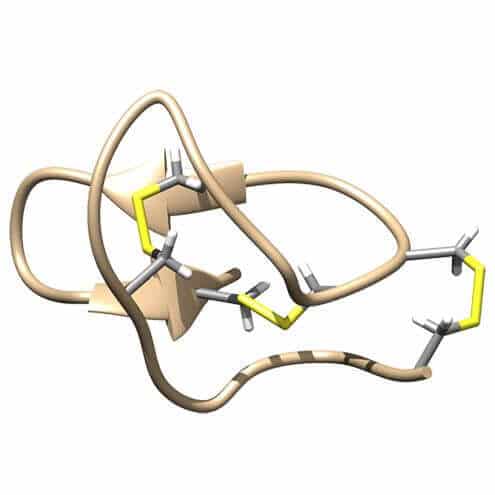
ω-Conotoxin GVIA
(GVIA-001)
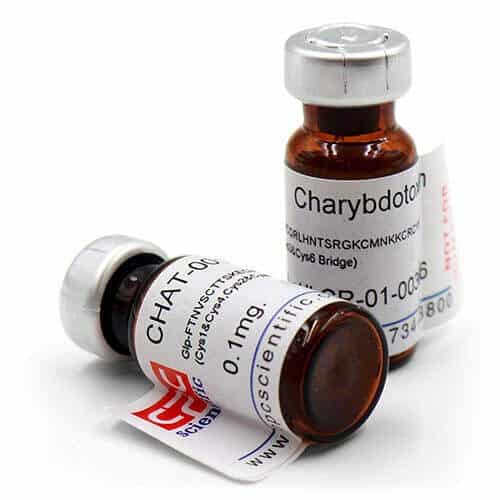
Charybdotoxin
(CHAT-001)
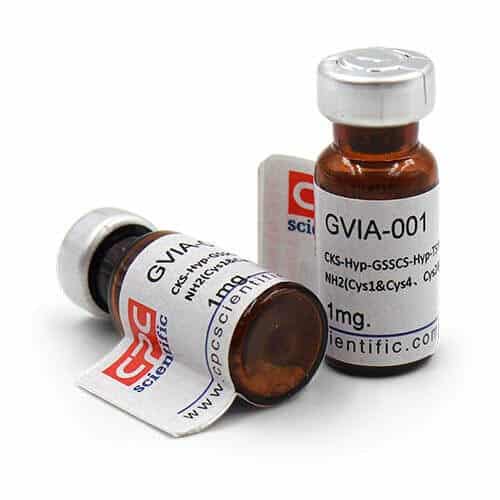
ω-Conotoxin GVIA
(GVIA-001)
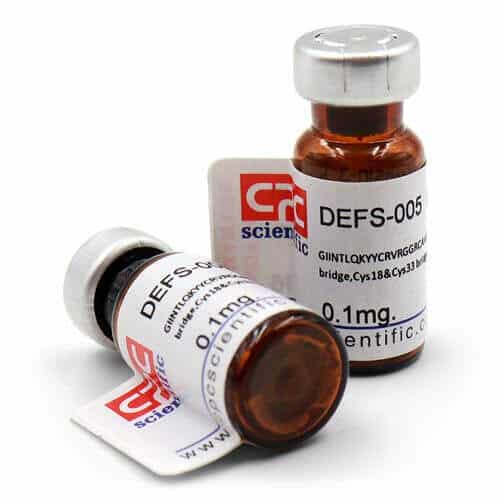
β-Defensin-3, human
(DEFS-005)
Multiple Bridged Peptide Citations
McGonigle, Sharon, Utpal Majumder, Donna Kolber-Simonds, Jiayi Wu, Andrew Hart, Thomas Noland, Karen TenDyke et al. Cell Communication and Signaling 17, no. 1 (2019): 67.
Native Cltx (Cltx-CONH2) was synthesized at CPC Scientific (Sunnyvale, CA) by routine methods and stored dry at -20 °C.
Lee, Chul-Jin, Mitra S. Rana, Chanhyung Bae, Yan Li, and Anirban Banerjee. Journal of Biological Chemistry 294, no. 1 (2019): 231-245.
Substrate-mimicking peptides for wild-type or mutant Wnts with a point-mutation, varying in lengths or the number of disulfide bonds were purchased from CPC Scientific (Sunnyvale, CA)..
Wilson, Sarah S., et al. PLoS Pathogens 13.6 (2017): e1006446.
"Cryptdin 2 (UniProtKB: P28309, LRDLVCYCRTRGCKRRERMNGTCRKGHLMYTLCCR)... obtained by oxidative refolding of partially purified linear peptides (synthesized by CPC Scientific...) and purifying the correctly folded species by reverse-phase high-pressure liquid chromatography (RP-HPLC). Purity was determined by analytical RP-HPLC, and the mass of the disulfide-bonded peptides was verified by high mass accuracy liquid chromatography-mass spectrometry."
Huang, Chung-Guei, et al. Oncotarget 8.21 (2017): 34820-34835
"Synthetic peptides of HPV 16 L1 (N′-C-KHTPPAPKEDPLKK-C′; position: 456−471)/E6 (N′-C-RTAMFQDPQERPRK-C′; position: 5−18) and a recombination protein of full-length HPV 16 E7-histag fusion protein (N′-MHGDTPTLHEYMLDLQPETTDLYCYEQLNDSSEEED-EIDGPAGQAEPDRAHYNIVTFCCKCDSTLRL-CVQSTHVDIRTLEDLLMGTLGIVCPICSQKP-C′; position: 1−98) were manufactured by CPC Scientific Inc."
Wiens, Mayim E., and Jason G. Smith. "Alpha-defensin HD5 inhibits furin cleavage of human papillomavirus 16 L2 to block infection." Journal of Virology 89, no. 5 (2015): 2866-2874.
"Folded HD5 was made from a synthesized 80% pure linearized peptide (CPC Scientific, Sunnyvale, CA) and purified by reverse-phase high-pressure liquid chromatography, and an HD5 derivative containing L-α-aminobutyric acid in place of cysteine (HD5 Abu) was chemically synthesized, as previously described.."
Wilson, Sarah S., et al. Mucosal Immunology 8.2 (2015): 352-361.
"Folded Crp23 was created from a synthesized 80% pure linear peptide (CPC Scientific, Sunnyvale, CA) by the same procedure as previously reported for the α-defensin HD5"
Gounder, Anshu P., et al. Journal of Biological Chemistry 287.29 (2012): 24554-24562.
"..folded HD5 was generated from a synthesized 80% pure linear peptide (CPC Scientific, Sunnyvale, CA) by thiol disulfide reshuffling overnight at room temperature in the presence of 3 mM reduced and 0.3 mM oxidized glutathione, 2 M guanidine hydrochloride, and 0.25 M sodium bicarbonate, pH 8.3, at a peptide concentration of 0.25 mg/ml [..] All α-defensins were quantified by UV absorbance at 280 nm using calculated molar extinction coefficients (18)."
Llenado, R. Alan, et al. Infection and Immunity 77.11 (2009): 5035-5043.
"(R/K)-RMAD-4 [rhesus myeloid α-defensin 4] [(R1/2/5/7/10/13/14/26/33K)-RMAD-462-94] was custom synthesized by CPC Scientific, Inc. (San Jose, CA) and refolded as described previously…"