
The development of peptoid-based therapeutics offers a broad range of modular diversity due to the availability of synthetic building blocks. Compared to traditional alpha- and beta-peptides, peptoid-peptide hybrids provide access to distinct conformational spaces and diversity. Incorporating mixtures of peptide and peptoid residues into a sequence allows for the synthesis of oligomers and polymers with unique numbers of backbone atoms between side chains. The ability to vary distances between side chains combined with an extensive side-chain diversity allows researchers to more easily modulate peptoid therapeutics towards enhanced binding affinities, lower cytotoxicity, better solubility, and increased cell-permeability.
In addition to changes in backbone periodicity for peptide-peptoid hybrids, peptoid residues can also expand into the space of cis-conformations, a configuration often absent in the typically trans amide bonds found in peptides and proteins.
Peptoid Building Block Examples

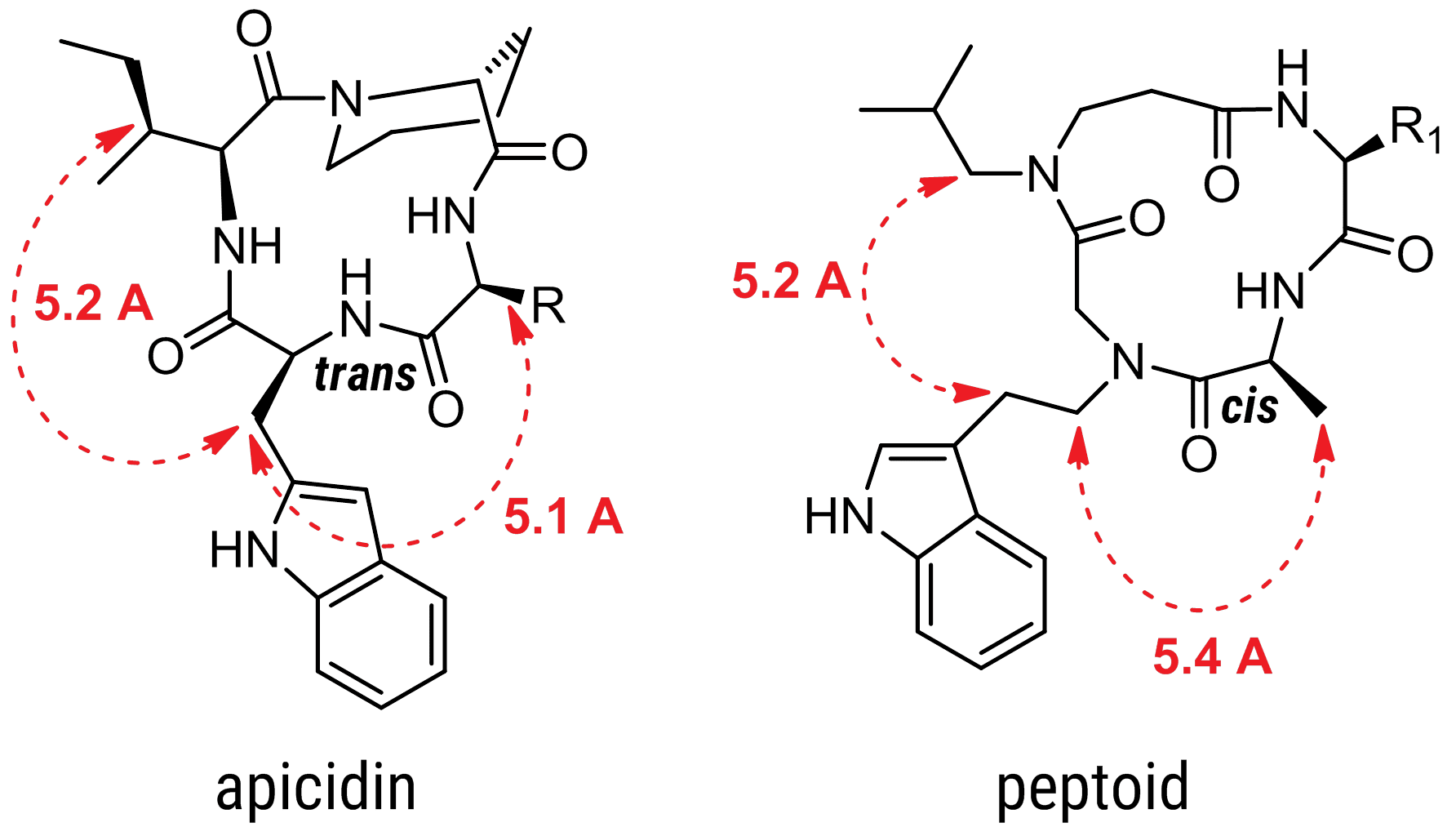
Ampocidin[1] is an important natural product macrocycle that inhibits histone deacetylase (HDAC). HDAC inhibitors are promising therapuetic compounds for anticancer chemotherapy. Professor Ghadiri at The Scripts Resaerch Institute has developed a series of macrocyclic peptoid-peptide hybrides; one of which, selectively inhibits class I HDAC forms, but does not inhibit tubulin deacylase in class IIb HDAC6 (Figure below). In comparing the NMR structures of apicidin (left) to Ghadiri’s peptoid-peptide hybrid (right), the distances between the pharmacophoric (molecular features required for molecular recognition) side chains are almost identical, despite the different cis-trans configurations of the amide bonds.
Boehm, M., Beaumont, K., Jones, R.M., Kalgutkar, A.S., Zhang, L., Atkinson, K., Bai, G., Brown, J.A., Eng, H., Goetz, G.H. and Holder, B.R. Journal of Medicinal Chemistry (2017).
Olsen, Christian A., Ana Montero, Luke J. Leman, and M. Reza Ghadiri. ACS Medicinal Chemistry Letters 3, no. 9 (2012): 749-753.
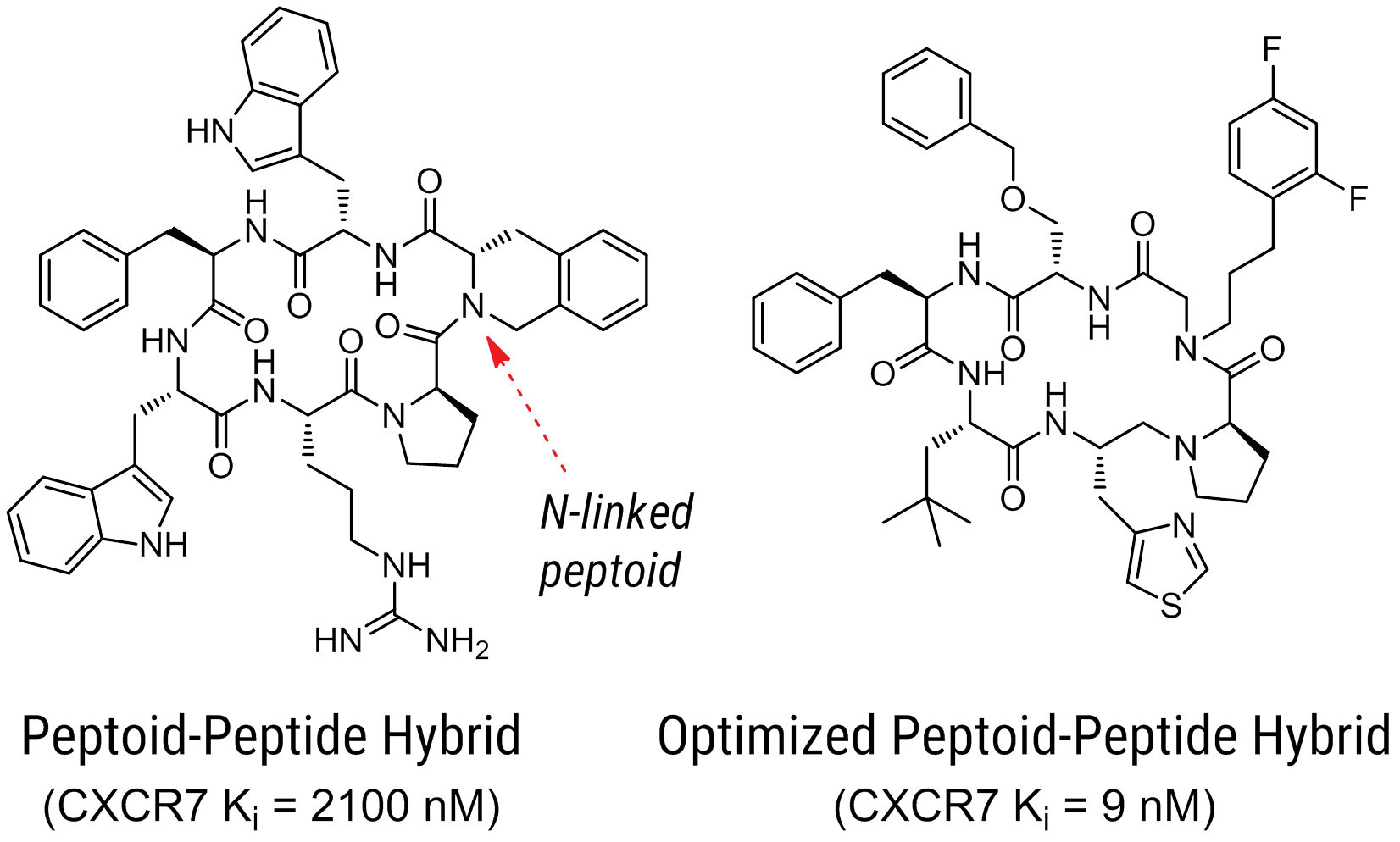
Peptoids, particularly macrocyclic peptoids, offer advantages over some small molecule drugs because of their receptor selectivity, potency, and reduced off-target activity. Researchers from Pfizer, UC Santa Cruz, UCSF, and Circle Pharma have developed peptoid ligands that selectively bind receptor CXCR7.1 The chemokine receptor CXCR7 is a G-protein-coupled receptor recognized to have high affinity to ligand CXCL12 (know also as SDF-1).[2] CXCL12 is known to stimulate B cell lymphopoiesis and bone marrow myelopoiesis.
References
- Olsen, Christian A., Ana Montero, Luke J. Leman, and M. Reza Ghadiri. ACS Medicinal Chemistry Letters 3, no. 9 (2012): 749-753.
- Boehm, M., Beaumont, K., Jones, R.M., Kalgutkar, A.S., Zhang, L., Atkinson, K., Bai, G., Brown, J.A., Eng, H., Goetz, G.H. and Holder, B.R. Journal of Medicinal Chemistry (2017).
Peptoid Citations
Boehm, M., Beaumont, K., Jones, R.M., Kalgutkar, A.S., Zhang, L., Atkinson, K., Bai, G., Brown, J.A., Eng, H., Goetz, G.H. and Holder, B.R. Journal of Medicinal Chemistry (2017).
- Pfizer Worldwide Research & Development, Cambridge, Massachusetts 02139, United States
- Pfizer Worldwide Research & Development, Groton, Connecticut 06340, United States
The chemokine receptor CXCR7 is an attractive target for a variety of diseases. While several small-molecule modulators of CXCR7 have been reported, peptidic macrocycles may provide advantages in terms of potency, selectivity, and reduced off-target activity