
Most proteinogenic-based peptides, with the exception of some hydrophobic sequences, can be synthesized in a linear fashion by solid-phase peptide synthesis (SPPS) methodologies. Longer sequences, however, particularly sequences that exceed 70 amino acids in length, often require alternative techniques to synthesize. Poor solvation of the protected peptide during synthesis and the formation of intermolecular hydrogen bonds (i.e., β-sheets) among fragments can result in inefficient coupling and deprotection.
CPC Scientific has experience in the synthesis of long peptide sequences. We employ a variety of strategies to overcome poor solvation and aggregation; some of these methods include:
- Polar solvent mixtures (e.g., “Magic Mixture”,[1,2] chaotropic salt additives)
- Increased temperatures and microwave irradiation
- Protected fragment condensation
- Native Chemical Ligation (i.e., unprotected fragment condensation)
- Low resin substitution and high-swelling resins
To help mitigate aggregation in SPPS, polar solvent cocktails have been developed to increase reaction mixture polarity and introduce hydrogen bond acceptors to compete with β-sheets that form between peptide fragments. The “Magic Mixture”, introduced in 1992 by Kent and co-workers, contains DMF/DCM/NMP (1:1:1), 1% Triton X-100, and 2 M ethylenecarbonate (a strong hydrogen-bond donor) has lead to improved coupling efficiencies in linear peptides and on-resin cyclizations.[3] Other additives such as chaotropic salts (LiCl, KSCN, guanidine HCl) have be shown to also reduce aggregation caused by peptide secondary structure.
While chaotropic additives, polar cocktails, and high-swelling resins have improved coupling efficiencies in SPPS for longer peptides, their benefits diminish with length and the resultant crude peptides can be exceptionally challenging to purify. Condensation of orthogonally protected peptide fragments have met some of these challenges. In 1973, Wang introduced p-alkoxybenzyl alcohol and p-alkoxybenzyloxycarbonylhydrazide resins suitable for the synthesis of protected peptide fragments bearing a free carboxylic acid or hydrazide group.[4] The preparation of protected fragment is relatively easy for short peptide fragments; however, longer fragments (>10 AAs) can suffer from poor solubility. In addition, coupling of fragments without a C-terminal glycine residue, can result in peptide diastereomers.
A simple technique was devised by Dawson and Kent in 1994 that allows the direct synthesis of large peptides and native proteins of moderate size that overcame most of the obstacles associated with the coupling of protected fragments.[5] Native chemical ligation of unprotected peptide fragments involves the reaction between a terminal cysteine-peptide and a peptide-α-thioester. Peptide-α-thioalkyl esters are easy to prepare and relatively unreactive to unprotected side chains of the amino acids. The low reactivity of the esters enable the couplings to proceed with side chain protection groups, making the fragments much easier to dissolve. The only drawback of Native chemical ligation is the requirement of a cysteine residue, but in large peptides and proteins, cysteines are relatively abundant.
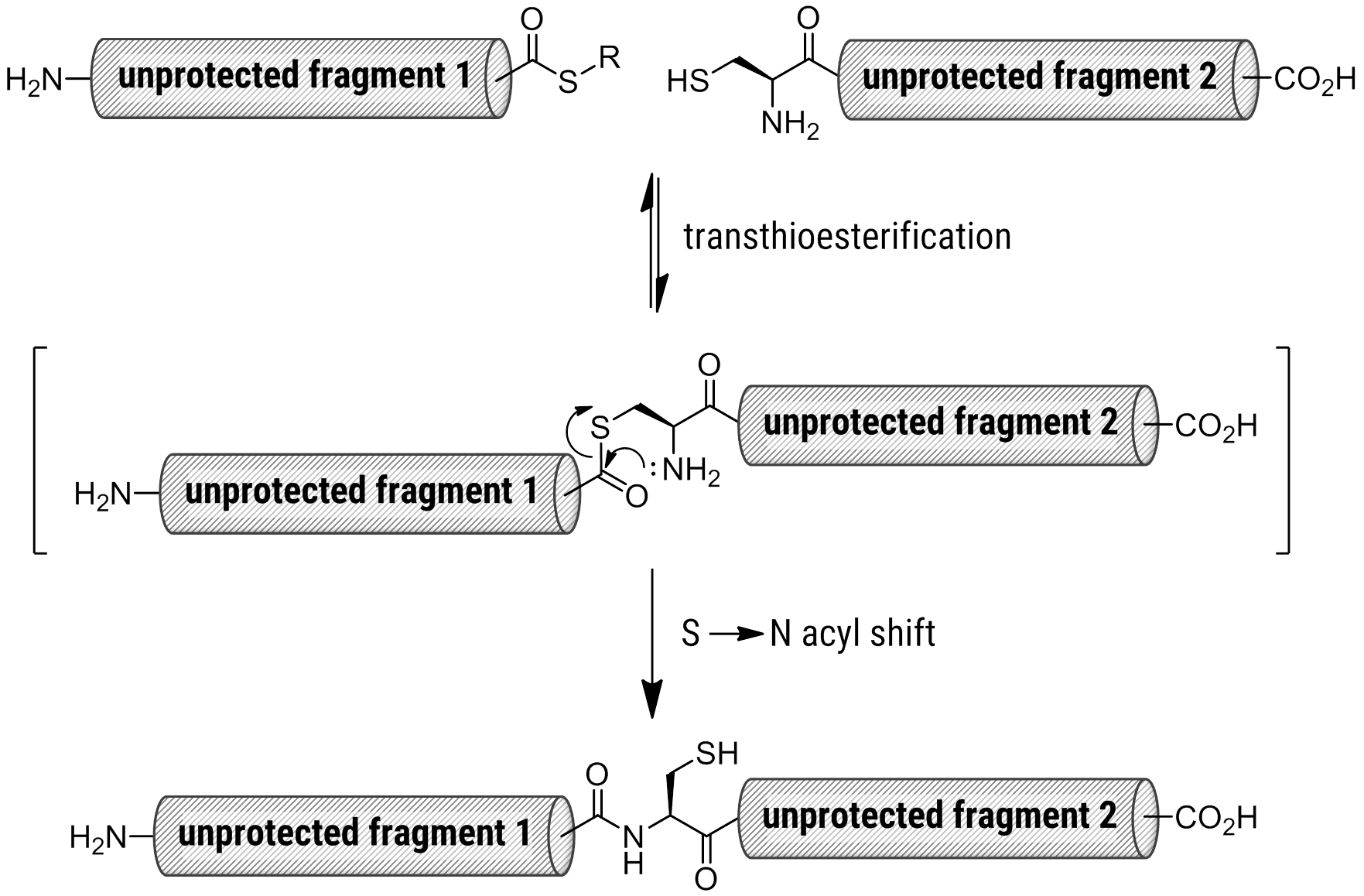
Figure. Mechanism of Native Chemical Ligation.
Long Peptide Citations
Buss, Colin G., and Sangeeta N. Bhatia. Proceedings of the National Academy of Sciences (2020).
Tandem Peptides. Tandem peptides were purchased from CPC Scientific. Sequences are: mTP-TAMRA-LyP1 (Myr-GWTLNSAGYLLGKINLKALA-ALAKKILGGGGK(5TAMRA)-CGNKRTRGC (C-C bridge)); [..] PEGylated formulations of these peptides were synthesized as previously described (49). The sequences are: [..] mTP-PEG-ARAL (Myr-GWTLNSAGYLLGKINLKALA-ALAKKILC-PEG5K-GGGARALPSQRSR).
Lo, J.H., Hao, L., Muzumdar, M.D., Raghavan, S., Kwon, E.J., Pulver, E.M., Hsu, F., Aguirre, A.J., Wolpin, B.M., Fuchs, C.S. and Hahn, W.C. Molecular Cancer Therapeutics 17, no. 11 (2018): 2377-2388.
pTP-TAMRA-iRGD (CH3(CH)15-[GWTLNSAGYLLGKINLKALAALAKKIL-GGK(TAMRA)GGCRGDKGPDC, Cys-Cys bridge]) used in all figures except Fig. S1 was synthesized by CPC Scientific.
Gilles, Maud-Emmanuelle, Slack, Frank J, et al. Oncotarget, 2019, Vol. 10, (No. 51), pp: 5349-5358
"Tandem peptide (pTP-iRGD: CH3(CH)15-GWTLNSAGYLLGKINLKALAALAKKIL-GGK(TAMRA)GGCRGDKGPDC, Cys-Cys bridge) was synthesized by CPC Scientific."
Weaver, Clarissa L., et al. Biochemistry 56.15 (2017): 2071-2075.
"The peptide, NCysRepA50mer (C MNQSFISDIL YADIESKAKE LTVNSNNTVQ PVALMRLGVF VPKPSKSKGE), was synthesized by CPC Scientific (Sunnyvale, CA). "
Huang, Chung-Guei, et al. Oncotarget 8.21 (2017): 34820-34835
"Synthetic peptides of HPV 16 L1 (N′-C-KHTPPAPKEDPLKK-C′; position: 456−471)/E6 (N′-C-RTAMFQDPQERPRK-C′; position: 5−18) and a recombination protein of full-length HPV 16 E7-histag fusion protein (N′-MHGDTPTLHEYMLDLQPETTDLYCYEQLNDSSEEED-EIDGPAGQAEPDRAHYNIVTFCCKCDSTLRL-CVQSTHVDIRTLEDLLMGTLGIVCPICSQKP-C′; position: 1−98) were manufactured by CPC Scientific Inc."
Skjevik, Åge Aleksander, et al. Journal of Molecular Biology 426.1 (2014): 150-168.
"The peptides TH-(1-43) (MPTPDATTPQAKGFRRAVSELDAKQAEAIMSPRFIGRRQSLIE) and THp-(1-43) (MPTPDATTPQAKGFRRAVS(PO3)2-ELDAKQAEAIMSPRFIGRRQSLIE) were synthesized by CPC Scientific (San Jose, CA) at approximately 90% purity, as seen by mass spectroscopy, and used without further purification."
References
- Kent SB, et al. In: Innovations and Perspectives in Solid Phase Synthesis. Epton R, editor. Andover: Intercept Ltd.; 1992. p. 1.
- L. Zhang, C. Goldammer, B. Henkel, F. Zühl, G. Panhaus, G.Jung, E. Bayer, in “3rd lnternational Symposium on Innovation and Perspectives in SPPS, Oxford UK,” R Epton Ed., Mayflower Scientific Ltd, Birmingham 1994, 711.
- Thakkar, Amit, Thi Ba Trinh, and Dehua Pei. “Global analysis of peptide cyclization efficiency.” ACS Combinatorial Science 15, no. 2 (2013): 120-129.
- Wang, Su-Sun. “p-Alkoxybenzyl alcohol resin and p-alkoxybenzyloxycarbonylhydrazide resin for solid phase synthesis of protected peptide fragments.” Journal of the American Chemical Society 95, no. 4 (1973): 1328-1333.
- Dawson, Philip E., Tom W. Muir, Ian Clark-Lewis, and S. B. Kent. “Synthesis of proteins by native chemical ligation.” Science 266, no. 5186 (1994): 776-779.