
Molecular imaging techniques play a critical role in modern clinical and experimental diagnostics. Fluorescently labeled reporter molecules can provide biological information at the molecular level in living systems, enable visualization of the specific molecular events in disease process, and monitor therapeutic responses. As an important molecular imaging technology, fluorescent imaging has specific advantages over other imagaing techiques, such as high sensitivity, use of nonradioactive materials, and easy detection by lower cost instruments.
Dye Chemistry
Fluorescence is a process that occurs in particular molecules that are termed fluorophores or fluorescent dyes (Figure 1). The fluorescent process is initiated when a photon of energy is supplied by an external source (laser or incandescent lamp) and is absorbed by a fluorophore to create an excited electronic singlet state (S1). The excited state lasts for only 1–10 nanoseconds; however, during this time, the energy of (S1) partially dissipates, yielding a relaxed singlet state with respect to the original fluorescence emission. When the fluorophore returns to the ground state ((S0), a photon of energy is emitted. Because of the energy that was dissipated during the excited-state lifetime, the energy of the photon is lower than what was initially supplied and therefore is of a longer wavelength. Absorption spectrophotometry differs from fluorescent spectroscopy in that emission wavelength is the same as the excitation wavelength. For example, dabsyl (4-(4-Diethylaminophenylazo)-benzenesulfonyl) is nonfluorescent dye with an absorption and emission peak at 454 nm. AMC (7-Amino-4-methylcoumarin) dye, on the other hand, is fluorescent because it has an absorption peak at 350 nm and an emission peak a 450 nm.
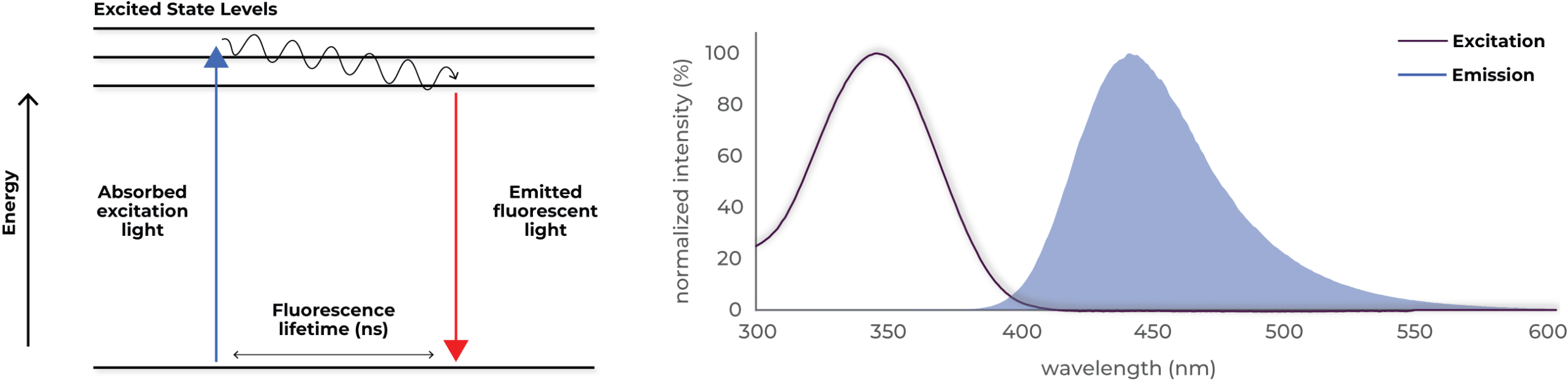
Figure 1. Jablonski diagram illustrating the processes involved in the creation of an excited electronic singlet state by optical absorption and subsequent emission of fluorescence (Left). The fluorescent spectrum of AMC (7-Amino-4-methylcoumarin) dye shows an absorption peak at 350 nm and an emission peak at 450 nm (Right).
Molecular chromophors and fluorescent dyes may be incorporated at variety of positions in a peptide, including the (1) N-terminus, (2) C-terminus, and (3) side-chains of amino acids such as lysine, glutamic acid, and asparatic acid.
Fluorescent Dye Chemical Structures
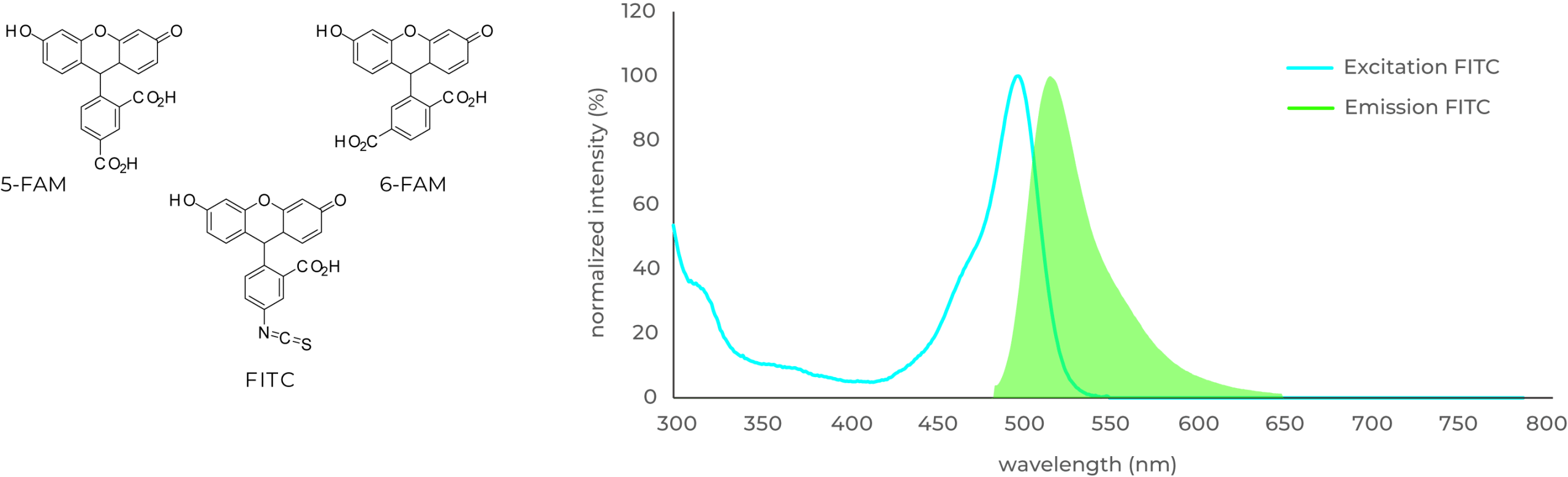
Carboxyfluorescein (abbreviated, FAM) is one of the most popular fluorescent tags for peptides. FAM conjugations often out perform in stability over its counterpart, fluorescein-isothiocyanate (FITC). FAM carboxamide conjugates are generally more stable to hydrolysis than are FITC conjugates.
Fluorescein Excitation and Emission Spectrum
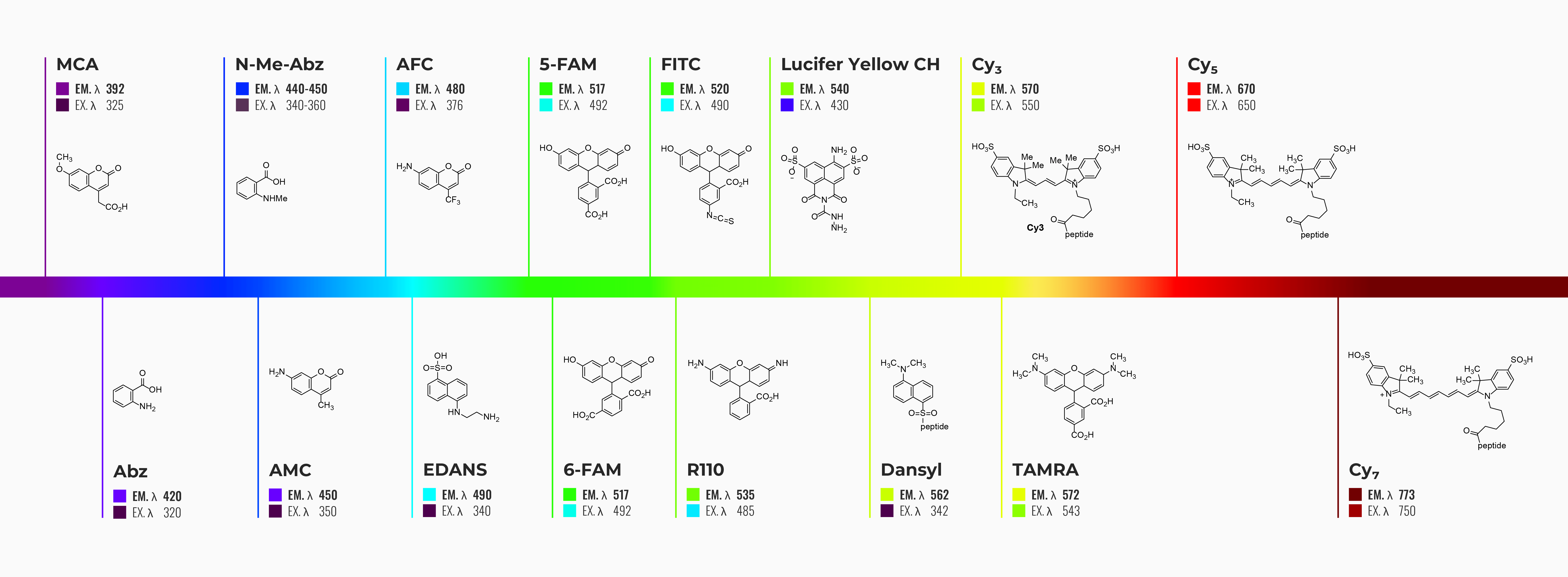
Common Dyes for Peptide Conjugation
| DYE | FULL NAME | EX. λ | EM. λ | Extinction Coeff. M-1 cm-1 (ε) | ||
|---|---|---|---|---|---|---|
| MCA | 7-Methoxycoumarin-4-acetic acid | 325 | ▉ | 392 | ▉ | 11,820 |
| Abz | 2-Aminobenzoyl or Anthraniloyl | 320 | ▉ | 420 | ▉ | |
| N-Me-Abz | N-Methyl-anthranilyl or N-Methyl-2-Aminobenzoyl | 340- 360 | ▉ | 440- 450 | ▉ | |
| AMC | 7-Amino-4-methylcoumarin | 350 | ▉ | 450 | ▉ | 19,000 |
| Dabcyl | 4-(4-Diethylaminophenylazo)-benzenesulfonyl | 454 | ▉ | NA | 32,000 | |
| AFC | 7-Amino-4-trifluoromethylcoumarin | 376 | ▉ | 480 | ▉ | 17,000 (EtOH) |
| EDANS | 5-((2-Aminoethyl)amino)naphthalene-1-sulfonic acid | 340 | ▉ | 490 | ▉ | 5,900 |
| 5-FAM | 5-Carboxyfluorescein | 492 | ▉ | 517 | ▉ | 83,000 |
| 6-FAM | 6-Carboxyfluorescein | 492 | ▉ | 517 | ▉ | |
| CP488 | equivalent to Alexa Fluora | 491 | ▉ | 518 | ▉ | |
| FITC | Fluorescein isocyanate | 490 | ▉ | 520 | ▉ | 73,000 |
| R110 | Rhodamine 110 | 485 | ▉ | 535 | ▉ | 81,000 |
| Lucifer Yellow CH | 6-amino-2-[(hydrazinylcarbonyl)amino]-2,3-dihydro-1,3-dioxo-1H-benz[de]isoquinoline-5,8-disulfonic acid, dilithium salt | 430 | ▉ | 540 | ▉ | 11,000 |
| Dansyl | 5-(Dimethylamino) naphthalene-1-sulfonyl | 342 | ▉ | 562 | ▉ | 3,300 |
| Cy3 | 3-[2-[(E,3E)-3-[1-(5-carboxypentyl)-3,3-dimethylindol-2-ylidene]prop-1-enyl]-3,3-dimethylindol-1-ium-1-yl]propane-1-sulfonate | 550 | ▉ | 570 | ▉ | 150,000 |
| TAMRA | 5-Carboxytetramethyl rhodamine | 543 | ▉ | 572 | ▉ | 90,000 |
| Cy5 | 3-[2-[(1E,3E,5E)-5-[1-(5-carboxypentyl)-3,3-dimethylindol-2-ylidene]penta-1,3-dienyl]-3,3-dimethylindol-1-ium-1-yl]propane-1-sulfonate | 650 | ▉ | 670 | ▉ | 250,000 |
| Cy7 | 1-(5-carboxypentyl)-2-[(1E,3E,5E,7Z)-7-(1-ethyl-5-sulfo-3H-indol-2-ylidene)hepta-1,3,5-trienyl]-3H-indol-1-ium-5-sulfonate | 750 | ▉ | 773 | ▉ |
Dye-Labeled Peptide Citations
Chayanon Ngambenjawong, Henry Ko, Tahoura Samad, Novalia Pishesha, Hidde L. Ploegh, and Sangeeta N. Bhatia. ACS Nano 2025 19 (10), 9958-9970.
Therapeutic peptides and their Cy7-labeled analogs (Table S1 and Figure S14) were synthesized by CPC Scientific (CA, U.S.A.) via standard Fmoc-based SPPS.
Dakin, L.A., Xing, L., Hall, J. et al. Nat Commun 16, 4579 (2025).
The enzymatic reaction was started with the addition of 8 µM of substrate Atto655 - (Ser-Arg-Gly-Ala)3 (CPC Scientific Inc.) in assay buffer.
J. Zeng, G.W.Z. Loi, E.N. Saipuljumri, M.A. Romero Durán, O. Silva-García, J.M. Perez-Aguilar, V.M. Baizabal-Aguirre, & C.H. Lo. Proc. Natl. Acad. Sci. U.S.A. 2024 121 (14).
FKC (FKCRRWQWRMKK-NH2), rhodamine-conjugated FKC (Rho-FKCRRWQWRMKK-NH2), and IDR (VQRWLIVWRIRK-NH2) peptides were synthesized using solid phase F-moc chemistry by CPC Scientific, Inc. with a purity greater than 95%.
Alvarez, N., Adam, G.C., Howe, J.A., Sharma, V., Zimmerman, M.D., Dolgov, E., Rasheed, R., Nizar, F., Sahay, K., Nelson, A.M. and Park, S. Viruses 16, no. 7 (2024): 1158.
- Center for Discovery and Innovation, Hackensack Meridian Health, 111 Ideation Way, Nutley, NJ 07110, USA
- Merck & Co., Inc., Rahway, NJ 07065, USA
The enzymatic activity of recombinantly expressed 3CLPro enzymes from different coronaviruses was measured using the following synthetic quenched FRET peptide: CP488-ESATLQSGLRKAK- (CPQ2)-NH2 (CPC Scientific, San Jose, CA, USA).
Hao, Liangliang, Natalie Boehnke, Susanna K. Elledge, Nour-Saïda Harzallah, Renee T. Zhao, Eva Cai, Yu-Xiong Feng et al. Proceedings of the National Academy of Sciences 121, no. 11 (2024): e2307802121.
The azido-modified biosensor peptide (sequence B(biotin)-eGvndneeGffsarK-(FAM)dGGPLGVRGKK-(N3)) was synthesized by CPC Scientific with >90% purity.
Yarovaya, Olga I., Aleksandr S. Filimonov, Dmitriy S. Baev, Sophia S. Borisevich, Anna V. Zaykovskaya, Varvara Yu Chirkova, Mariya K. Marenina et al. " Viruses 16, no. 2 (2024): 215.
Fluorescence was observed by an assay involving a synthetic fluorescently labeled peptide substrate of the type DabcylKTSAVLQ↓SGFRKME(Edans)NH2 (more than 95% purity, CPC Scientific Inc., Hangzhou, China) containing the site digested by the main protease of coronavirus. The fluorescent dye attached to the peptide substrate allows the FRET effect to be implemented [..]
Shurtleff, V.W., Layton, M.E., Parish, C.A., Perkins, J.J., Schreier, J.D., Wang, Y., Adam, G.C., Alvarez, N., Bahmanjah, S., Bahnck-Teets, C.M. and Boyce, C.W. Journal of Medicinal Chemistry 67, no. 5 (2024): 3935-3958.
- Center for Discovery and Innovation, Hackensack Meridian Health. 111 Ideation Way. Nutley, New Jersey 07110, United States.
- Merck & Co., Inc., Rahway, New Jersey 07065, United States.
The enzymatic activity of recombinantly expressed 3CLPro enzymes from different coronaviruses was measured using the following synthetic quenched FRET peptide: CP488-ESATLQSGLRKAK- (CPQ2)-NH2 (CPC Scientific, San Jose, CA.
Kikuchi, F., Ikeda, Z., Kakegawa, K., Nishikawa, Y., Sasaki, S., Fukuda, K., Takami, K., Banno, Y., Nishikawa, H., Taya, N. and Nakahata, T. Bioorganic & Medicinal Chemistry 93 (2023): 117462.
- Research, Takeda Pharmaceutical Company Limited, 26-1, Muraoka-Higashi 2-chome, Fujisawa, Kanagawa 251-8555, Japan
- Pharmaceutical Sciences, Takeda Pharmaceutical Company Ltd., 26-1, Muraoka-Higashi 2-chome, Fujisawa, Kanagawa 251-8555, Japan
5FAM-Abu-Gly-Asp-Asp-Asp-Lys-Ile-Val-Gly-Gly-Lys(CPQ2)-Lys-Lys-NH2 (purity: 97.2%, CPC Scientific, Inc.) was diluted with an assay buffer to prepare a 5.4 μM substrate solution.
Ikeda, Z., Kakegawa, K., Kikuchi, F., Itono, S., Oki, H., Yashiro, H., Hiyoshi, H., Tsuchimori, K., Hamagami, K., Watanabe, M. and Sasaki, M. Journal of Medicinal Chemistry 65, no. 12 (2022): 8456-8477.
- Research, Takeda Pharmaceutical Company Limited, 26-1, Muraokahigashi 2-chome, Fujisawa, Kanagawa 251-8555, Japan
Subsequently, 5FAM–Abu–Gly–Asp–Asp–Asp–Lys–Ile–Val–Gly–Gly–Lys(CPQ2)–Lys–Lys–NH2 (purity: 97.2%, CPC Scientific, Inc.) was diluted with an assay buffer to prepare a 2.1 μM substrate solution.
Bekdemir, Ahmet, Eden EL Tanner, Jesse Kirkpatrick, Ava P. Soleimany, Samir Mitragotri, and Sangeeta N. Bhatia Advanced Healthcare Materials (2022): 2102685.
Peptides [TDN-qFAM, C-(PEG)2-K(CPQ2)-GGGSRPfGG-5FAM] were obtained from Tufts University Peptide Core Facility or CPC Scientific, Inc (USA)
Mac, Quoc D., Anirudh Sivakumar, Hathaichanok Phuengkham, Congmin Xu, James R. Bowen, Fang-Yi Su, Samuel Z. Stentz et al. Nature Biomedical Engineering (2022): 1-15.
"FITC-labelled GzmB substrate peptides with internal quencher ((5FAM)aIEFDSG(K-CPQ2)kkc) were synthesized by CPC Scientific and used for all in vitro activity assays. [..] Quenched fluorescent peptides for screening candidate substrates ((5FAM)-{substrate}-(K-DABCYL)-amide"
Lopez, Andrea, Denis E. Reyna, Nadege Gitego, Felix Kopp, Hua Zhou, Miguel A. Miranda-Roman, Lars Ulrik Nordstrøm et al. Nature Communications 13, no. 1 (2022): 1-18.
"Hydrocarbon-stapled peptide corresponding to the BH3 domain of BIM, FITC-BIM SAHBA2: FITC-βAla-EIWIAQELRS5IGDS5F’NAYYA-CONH2, where S5 represents the non-natural amino acid inserted for olefin metathesis, was synthesized, purified at >95% purity by CPC Scientific Inc."
Soleimany, Ava P., [..] Sangeeta N. Bhatia. Cancer Research 81, no. 1 (2021): 213-224.
All peptides were synthesized by CPC Scientific (Sunnyvale, CA) and reconstituted in dimethylformamide (DMF) unless otherwise specified. Sequences are provided in Supplementary Table S1.
Cazanave, S.C., Warren, A.D., Pacula, M., Touti, F., Zagorska, A., Gural, N., Huang, E.K., Sherman, S., Cheema, M., Ibarra, S. and Bates, J. Science Translational Medicine 13, no. 616 (2021): eabe8939.
All peptides were synthesized by CPC Scientific Inc. For fluorogenic assays, peptides were flanked with the fluorophore-quencher pair 5-FAM-CPQ2. For in vivo urine experiments, peptides were barcoded with Glu-Fib–derived and heavy isotope–labeled peptides. PEGylated peptides were pooled prepared before in vivo experiments and stored at 4°C in phosphate-buffered saline.
Zeming, K. K.; Lu, R.; Woo, K. L.; Sun, G.; Quek, K. Y.; Cheow, L. F.; Chen, C.-H.; Han, J.; Lim, S. L. Analytical Chemistry 2021.
The FRET substrates used in this project are: neutrophil elastase substrate ((Z-AAAA)2Rh110 Abs/Em:497/520 nm, Anaspec), Granzyme B substrate (5TAMRA-VGPDFGR-K(QSY7)-NH2 Abs/Em: 546/580, CPC scientific), and metalloproteinase substrate (QSY21-HGDQMAQKSK(Cy5)-NH2 Abs/Em:649/666 nm, CPC Scientific).
Chan, Leslie W., Melodi N. Anahtar, Ta-Hsuan Ong, Kelsey E. Hern, Roderick R. Kunz, and Sangeeta N. Bhatia. Nature Nanotechnology (2020): 1-9.
HFA-modifed peptides were synthesized by CPC Scientifc (>95% purity). Briefy, the peptide substrate, Ac-CKKK(Cy5)-PEG4-Nle(O-Bzl)-Met(O)2-Oic-Abu-OH, was synthesized on Fmoc-Abu-CTC resin via standard Fmoc solid phase peptide synthesis.
Belenkaya, S. V., A. A. Bondar, T. A. Kurgina, V. V. Elchaninov, A. Yu Bakulina, E. A. Rukhlova, O. I. Lavrik, A. A. Ilyichev, and D. N. Shcherbakov. Biochemistry (Moscow), 2020.
A synthetic peptide of the following composition was used as a substrate: Dabcyl-HPHPHLSFMAIPK (5-FAM) KK-NH2 (Dabcyl = 4-(dimethylaminoazo) benzene-4-carboxylic acid, 5-FAM = 5-carboxyfluorescein) (CPC Scientific, USA) containing the Chn-sensitive region of bovine κ-casein.
Hao, Liangliang, Renee T. Zhao, Chayanon Ngambenjawong, Heather E. Fleming, and Sangeeta Bhatia. bioRxiv (2020).
All peptides were chemically synthesized by CPC Scientific, Inc. [..] K(N3)-ANP-GPVPLSLVMGGC [..] 5FAM-GGf-Pip-KSGGGK(CPQ2)-PEG2-GC
Buss, Colin G., and Sangeeta N. Bhatia. Proceedings of the National Academy of Sciences (2020).
Tandem Peptides. Tandem peptides were purchased from CPC Scientific. Sequences are: mTP-TAMRA-LyP1 (Myr-GWTLNSAGYLLGKINLKALA-ALAKKILGGGGK(5TAMRA)-CGNKRTRGC (C-C bridge)); [..] PEGylated formulations of these peptides were synthesized as previously described (49). The sequences are: [..] mTP-PEG-ARAL (Myr-GWTLNSAGYLLGKINLKALA-ALAKKILC-PEG5K-GGGARALPSQRSR).
Kudryashev, Julia A., Lauren E. Waggoner, Hope T. Leng, Nicholas H. Mininni, and Ester J. Kwon. ACS Sensors (2020).
Calpain substrate peptide (QSY21-QEVYGAMP-K(Cy5)-PEG2-GC- NH2) was synthesized by CPC Scientific Inc. (Sunnyvale, CA …
Lo, J.H., Hao, L., Muzumdar, M.D., Raghavan, S., Kwon, E.J., Pulver, E.M., Hsu, F., Aguirre, A.J., Wolpin, B.M., Fuchs, C.S. and Hahn, W.C. Molecular Cancer Therapeutics 17, no. 11 (2018): 2377-2388.
pTP-TAMRA-iRGD (CH3(CH)15-[GWTLNSAGYLLGKINLKALAALAKKIL-GGK(TAMRA)GGCRGDKGPDC, Cys-Cys bridge]) used in all figures except Fig. S1 was synthesized by CPC Scientific.
Ng, Ee Xien, Myat Noe Hsu, Guoyun Sun, and Chia-Hung Chen. Methods in Enzymology 628 (2019): 59-94.
The peptide sequences of the four FRET-based substrates ([..] CPC Scientific) are as follows: UV: AlexaFluor405-Leu-Ala-Gln-Ala-HompheArg-Ser-Lys (QSY35)-NH2; Blue: Dabcyl-Gly-Pro-Leu-Gly-Met-Arg-Gly-Lys (5-FAM)-NH2; Green: QSY7-Ala-Pro-Phe-Glu..
Artur Javmen, Vladimir Y. Toshchakov, et al. Journal of Leukocyte Biology (2019).
All CPDPs included the N‐terminal Antennapedia homeodomain sequence RQIKIWFQNRRMKWKK.38 The Cy3‐labeled peptides were produced by CPC Scientific (Sunnyvale, CA, USA). The Cy3 label was placed at the peptide N‐terminus..
Gilles, Maud-Emmanuelle, Slack, Frank J, et al. Oncotarget, 2019, Vol. 10, (No. 51), pp: 5349-5358
"Tandem peptide (pTP-iRGD: CH3(CH)15-GWTLNSAGYLLGKINLKALAALAKKIL-GGK(TAMRA)GGCRGDKGPDC, Cys-Cys bridge) was synthesized by CPC Scientific."
Garner, Thomas P., Dulguun Amgalan, Denis E. Reyna, Sheng Li, Richard N. Kitsis, and Evripidis Gavathiotis. Nature Chemical Biology 15, no. 4 (2019): 322.
"Hydrocarbon-stapled peptides corresponding to the BH3 domain of BIM, BIM SAHBA2: N-acetylated- and FITC-Ahx-EIWIAQELRS5IGDS5FNAYYA-CONH2, where S5 represents the non-natural amino acid inserted for olefin metathesis, were synthesized, purified at >95% purity by CPC Scientific Inc. and characterized as previously described."
Mac, Quoc D., Dave V. Mathews, Justin A. Kahla, Claire M. Stoffers, Olivia M. Delmas, Brandon Alexander Holt, Andrew B. Adams, and Gabriel A. Kwong. Nature Biomedical Engineering 3, no. 4 (2019): 281.
"FITC-labelled GzmB substrate peptides with internal quencher ((5-FAM)aIEFDSGK(CPQ2)kkc) were synthesized by CPC Scientific and used for all in vitro activity assays."
Rohani, Nazanin, Anthony R. Soltis et al. Cancer Research 79, no. 8 (2019): 1952-1966.
100 ul of 40μM Cy7 labled pHLIP peptide (N->C: AC(Cy7)DDQNPWRAYLDLLFPTDTLLLDLLW-DLys-DLys synthesized by CPC Scientific, Inc.)..
Sasaki, Masako, Ken‐ichi Hamagami et al. Pharmacology Research & Perspectives 7, no. 5 (2019): e00517.
- Research, Takeda Pharmaceutical Company Limited, Fujisawa, Kanagawa, Japan
The substrates QSY21‐Gly‐Asp‐Asp‐Asp‐Lys‐Ile‐Val‐Gly‐Gly‐Lys(Cy5) and 5FAM‐Abu‐Gly‐Asp‐Asp‐Asp‐Lys‐Ile‐Val‐Gly‐Gly‐Lys(CPQ2)‐Lys‐Lys‐NH2 were purchased from CPC Scientific (Sunnyvale, CA).
Hewings, D.S., Heideker, J., Ma, T.P., AhYoung, A.P., El Oualid, F., Amore, A., Costakes, G.T., Kirchhofer, D., Brasher, B., Pillow, T. and Popovych, N. Nature Communications 9, no. 1 (2018): 1162.
- Discovery Oncology, Genentech, South San Francisco, California, 94080, USA
- Early Discovery Biochemistry, Genentech, South San Francisco, California, 94080, USA
The 5-TAMRA (5-Carboxytetramethylrhodamine) peptide was generated by CPC-Scientific consisting of the sequence 5-TAMRA-YPYDVPDYAIREIVSRNKRRYQEDG. K63 or K48 tetra-Ub chains were conjugated to the peptide via its lysine residue [..]
Kategaya, L., Di Lello, P., Rougé, L., Pastor, R., Clark, K.R., Drummond, J., Kleinheinz, T., Lin, E., Upton, J.P., Prakash, S. and Heideker, J. Nature 550.7677 (2017): 534.
- Departments of Discovery Oncology, Early Discovery Biochemistry, Structural Biology, Discovery Chemistry, Biochemical and Cellular Pharmacology, Protein Chemistry, Microchemistry, Proteomics, and Lipidomics, Research Pathology, Bioinformatics and Computational Biology, and Translational Oncology, Genentech, South San Francisco, 94080, California, USA
- Department of Pharmaceutical Chemistry and Small Molecule Discovery Center, University of California, San Francisco, San Francisco, 94143, California, USA
- MRC Protein Phosphorylation and Ubiquitylation Unit, School of Life Sciences, University of Dundee, Dundee, DD1 5EH, UK
- Institute for Cell and Molecular Biosciences, Newcastle University, Newcastle upon Tyne, NE2 1HH, UK
"The 5-TAMRA (5-carboxytetramethylrhodamine) peptide was generated by CPCScientific consisting of the sequence 5-TAMRA-YPYDVPDYAIREIVSRNKRRYQEDG.."
Bainbridge, Travis W., et al. Scientific Reports 7.1 (2017): 12524.
- Protein Chemistry, Molecular Oncology, Discovery Chemistry, Cancer Immunology, and Neuroscience. Genentech Inc., South San Francisco, CA, 94080, USA
"ANP FAP and aP NIRF were synthesized by CPC Scientific (Sunnyvale, CA)… Another internally-quenched FRET peptide substrate (ANPFAP) for FAP has recently been reported and demonstrated for use as an activity-based, in vivo imaging tool. The peptide sequence contains two internal Gly-Pro dipeptide motifs, susceptible to FAP cleavage and a Cy5.5/QSY21, quenched-FRET pair."
Kwon, Ester J., et al. Advanced Materials 29.35 (2017).
"[..] synthesized for initial screening with FAM-conjugated lysine at the C-terminal end of the membrane-interactive peptide and with or without D[KLAKLAK]2 on the C-terminus using standard Fmoc chemistry[..] All peptides were synthesized with N-terminal myristic acid and C-terminal amine. [..] larger quantities of the peptides were synthesized by CPC Scientific to 90% purity"
Kwon, Ester J., Jaideep S. Dudani, and Sangeeta N. Bhatia. Nature Biomedical Engineering 1 (2017): 0054.
[..] MMP substrate, 5-FAM–GGPLGVRGKK(CPQ2)–PEG2–C; thrombin substrate, 5-FAM–GGfPRSGGGK(CPQ2)–PEG2–C; where 5-FAM is the 5-carboxyfluorescein fluorophore, CPQ2 is the quencher, PEG2 is the linker polyethylene glycol, [..] dye for urinary detection (biotin–CGPLGVRGKK(Cy7)eGvndneeGffsar; Cy7 is cyanine7). Targeting peptides were [..] cyclized: LyP1, C–K(5-FAM)–C6–CGNKRTRGC; iRGD, C–PEG2–CRGDKGPDC; where C6 is the 6-aminohexanoic acid linker [..]
Wang, X., Kurowski, S., Wu, W., Castriota, G.A., Zhou, X., Chu, L., Ellsworth, K.P., Chu, D., Edmondson, S., Ali, A. and Andre, P. Journal of Pharmacology and Experimental Therapeutics 360, no. 3 (2017): 476-483.
- Departments of Cardiometabolic Disease Biology, Discovery Pharmaceutical Sciences, In Vitro Pharmacology, and Discovery Chemistry, Merck Research Laboratories, Kenilworth, New Jersey.
- Lead Optimization Chemistry, Merck Research Laboratories, Rahway, New Jersey.
The 7-amido-4-thifluoromethylcoumarin (AFC) containing fluorescence substrate, CH3SO2-cyclohexyl-Gly-Gly-Arg-AFC (cyclohexyl-G-G-R-AFC) was custom synthesized by CPC Scientific (Sunnyvale, CA, USA)..
Barbieri, Christopher M., et al. Journal of Pharmacology and Experimental Therapeutics 360.3 (2017): 466-475.
- In Vitro Pharmacology and Cardiometabolic Diseases, Merck & Co., Inc., Kenilworth, New Jersey
"The 7-amido-4-thifluoromethylcoumarin (AFC) containing fluorescence substrate, CH3SO2-cyclohexyl-Gly-Gly-Arg-AFC (cyclohexylG-G-R-AFC) was custom synthesized by CPC Scientific (Sunnyvale, CA, USA)"
Lo, Justin H., et al. Bioconjugate Chemistry (2016).
"Myristoyl-transportan−LyP-1 tandem peptide was synthesized by CPC Scientific (sequence: myr-GGWTLNSAGYLLGKINLKALAALAKKIL-GGGG-CGNKRTRGC, Cys−Cys bridge). FAM-labeled LyP-1 bearing an azide (azidoacetyl-GGG-cyclo-(EGNKRTRGK)), FAM-labeled LyP-1 bearing a cysteine (C-K(5FAM)-C6-cyclo-(CGNKRTRGC)) and transportan bearing a C-terminal cysteine (myristic acid-GGWTLNSAGYLLGKINLKALAALAKKILC) were synthesized by CPC Scientific, Inc."
Hershey, David M., et al. BioRxiv (2016): 047555.
"A custom peptidewith the sequence 5-carboxymethylfluorescein-Thr-Gln-Thr-Val-Ala-Ala-Gly-Ser-Lys(CPQ2)-D-Arg-D-Arg was obtainedcommercially (CPC Scientific)"
Cuperus, T., van Dijk, A., Matthijs, M.G., Veldhuizen, E.J. and Haagsman, H.P. Scientific Reports 6, no. 1 (2016): 26622.
"D-CATH-2 (amino acid sequence: RFGRFLRKIRRFRPKVTITIQGSARF-NH2) and N-terminally FITC and TAMRA labeled peptides were generated by solid-phase synthesis using Fmoc-chemistry and purified to >95% purity by RP-HPLC by CPC Scientific Inc. (Sunnyvale, USA…"
Dudani, Jaideep S., et al. ACS Nano 9.12 (2015): 11708-11717.
"...protease activity are focused on functionalizing synthetic peptide substrates with reporters that emit ... In vivo, veiled nanosensors are selectively activated at the ..... sized by CPC Scientific, Inc. (V1: Biotin-PEG(5 kDa)-(KFAM)-..."
Kwong, Gabriel A., et al. Proceedings of the National Academy of Sciences 112.41 (2015): 12627-12632.
"Cysteine-terminated peptides (Q1 = 5FAM-GGPLGVRGKK(CPQ-2)-PEG2-C, CPC Scientific.."
Martinez, R., Blasina, A., Hallin, J.F., Hu, W., Rymer, I., Fan, J., Hoffman, R.L., Murphy, S., Marx, M., Yanochko, G. and Trajkovic, D. PloS One 10, no. 9 (2015): e0138616.
- Oncology Research Unit, Pfizer Worldwide Research and Development, 10724 Science Center Drive, San Diego, CA, 92121
The 60 minute enzymatic reaction contained 5 nM Mps1 catalytic domain (aa 510–857), 60 μM (~Km-level) ATP, 5 μM phosphoacceptor peptide substrate (5FAM-RQRRSIDDTIDSTRLFE-NH2; CPC Scientific, Sunnyvale, CA), 10 mM MgCl2, 4% DMSO (with or without inhibitor), 1 mM DTT, 0.01% Tween-20, 50 mM HEPES (pH 7.5).
Zhu, Shu, et al. Blood 126.12 (2015): 1494-1502.
"The custom-made thrombin-sensitive peptide azidoacetyl-AK(5FAM)-GALVPRGSAGK(CPQ2)-NH2 was obtained from CPC Scientific (Sunnyvale, CA) for click reactions to anti-CD61, as previously described."
Miles, Linde A., et al. PloS One 10.6 (2015): e0129103.
"Peptides corresponding to the substrate sequences L/VP4.1 and non-hydrolysable linker (NHL) were synthesized between a 5-carboxyfluorescein (5-FAM) fluorophore/CPC Quencher (CPQ2) quencher pair (CPC Scientific). Additional lysines were added for increased solubility giving final peptide sequences of CPQ2-IVYELQGP-K(5FAM)-KK-NH2 and CPQ2-GGSGGS-K(5FAM)-KK-NH2 for L/VP4.1 and NHL, respectively. The identity and sequence of the L/VP4.1 and NHL peptides were confirmed by CPC Scientific via LC-MS and determined to be 96.7% and 95.1% pure, respectively."
Pemovska, T., Johnson, E., Kontro, M., Repasky, G.A., Chen, J., Wells, P., Cronin, C.N., McTigue, M., Kallioniemi, O., Porkka, K. and Murray, B.W. Nature 519, no. 7541 (2015): 102-105.
- La Jolla Laboratories, Pfizer Worldwide Research & Development, San Diego, California 92121, USA.
The reactions were conducted in 50 ml volumes in 96-well plates and contained GST-tagged human-recombinant ABL1(T315I) kinase intracellular domain (1 nM), 3 mM phosphoacceptor peptide, 59 FAM- EAIYAAPFAKKK-OH (CPC Scientific, also known as ProfilerPro Peptide 2, Caliper Life Sciences), test compound (11-dose threefold serial dilutions, 2% DMSO final) or DMSO only, 1 mM dithiothreitol (DTT), 0.002% Tween-20 and 5 mM MgCl2 in 25 mM HEPES, pH 7.1
Vanderpool, D., Grimshaw, C.E., Lawson, J.D. and Ermolieff, J. Analytical Biochemistry 473 (2015): 46-52.
- Enzymology and Biophysical Chemistry Group, Takeda California, San Diego, CA 92121, USA
- Computational Sciences and Crystallography Group, Takeda California, San Diego, CA 92121, USA
The mobility shift assay substrate (5-FAM-IPTSPITTTYFFFKKK) was purchased from CPC Scientific (Sunnyvale, CA, USA).
Doron L, Coppenhagen-Glazer S, Ibrahim Y, Eini A, Naor R, Rosen G, Bachrach G. PLoS One. 2014 Oct 30;9(10):e111329.
"Fusolisin’s restriction specificity was verified using the FRET substrate CPQ2-Gly-Phe-Ile-Thr-Ala-Phe-Pro-Lys-(5FAM)-Arg-Arg-NH2 that was custom synthesized by CPC Scientific (Sunnyvale, CA, USA)."
Warren, Andrew D., et al. Journal of the American Chemical Society 136.39 (2014): 13709-13714.
"Thrombin-sensitive reporter 1 (R1) was synthesized by CPC Scientific, with the sequence Biotin-PEG5kDa-Lys(5FAM)-Gly-Gly-DPhe-Pro-Arg-Ser-Gly-Gly-Gly-Cys, where PEG5kDa is 5 kDa poly(ethylene glycol)."
Huang, Q., Johnson, T.W., Bailey, S., Brooun, A., Bunker, K.D., Burke, B.J., Collins, M.R., Cook, A.S., Cui, J.J., Dack, K.N. and Deal, J.G. Journal of Medicinal Chemistry 57, no. 4 (2014): 1170-1187.
- La Jolla Laboratories, Pfizer Worldwide Research and Development, 10770 Science Center Drive, San Diego, California 92121
The reactions were conducted in 50-μL volumes in 96-well plates and contained 1.3 nM wild-type or 0.5 nM mutant ALK, 3 μM phosphoacceptor peptide (5′FAM-KKSRGDYMTMQIG-CONH2, synthesized by CPC Scientific, Sunnyvale, CA)..
Xu, Y., Cai, T.Q., Castriota, G., Zhou, Y., Hoos, L., Jochnowitz, N., Loewrigkeit, C., Cook, J.A., Wickham, A., Metzger, J.M. and Ogletree, M.L. Thrombosis and Haemostasis 111, no. 04 (2014): 694-704.
- Departments of Thrombosis, Cardiometabolic Diseases and In Vivo Pharmacology, Merck Research Laboratories, Kenilworth, New Jersey, USA
CHG-GR-AFC (CPC Scientific, Sunnyvale, CA, USA) was used for rabbit FIXa and FXa, and human activated protein C.
Welsh, J. D., et al. Journal of Thrombosis and Haemostasis 10.11 (2012): 2344-2353.
"Thrombin-sensitive peptide (ThS-P) azidoacetyl alanine-K(5FAM)GALVPRGSAGK(CPQ2) was custom synthesized (2143 MW, > 95% purity; CPC scientific, Sunnyale, CA, USA) and dissolved in DMSO (20 mm ThS-P)."
Pacholec, M., Bleasdale, J.E., Chrunyk, B., Cunningham, D., Flynn, D., Garofalo, R.S., Griffith, D., Griffor, M., Loulakis, P., Pabst, B. and Qiu, X.Journal of Biological Chemistry 285, no. 11 (2010): 8340-8351.
- Departments of Cardiovascular, Metabolic and Endocrine Diseases, and Structural Biology, Pfizer Global Research and Development, Groton, Connecticut 06340
The p53-derived peptides, TAMRA-p53 peptide and native p53 peptide, were custom-synthesized by CPC Scientific.
Solowiej, J., Thomson, J.A., Ryan, K., Luo, C., He, M., Lou, J. and Murray, B.W. Biochemistry 47, no. 8 (2008): 2617-2630.
- Pfizer Global Research and DeVelopment, La Jolla, Pfizer Inc., 10777 Science Center Drive, San Diego, California 92121.
Peptide 4 [Dabcyl-KTSAVLQSGFRKME-Edans], peptide 5 [SITSAVLQ-pNA], and peptide 6 [SITSAVLQ-pNP] were purchased from CPC Scientific (San Jose, CA) and had the following purities: >95%, >93%, and >90.1%, respectively.