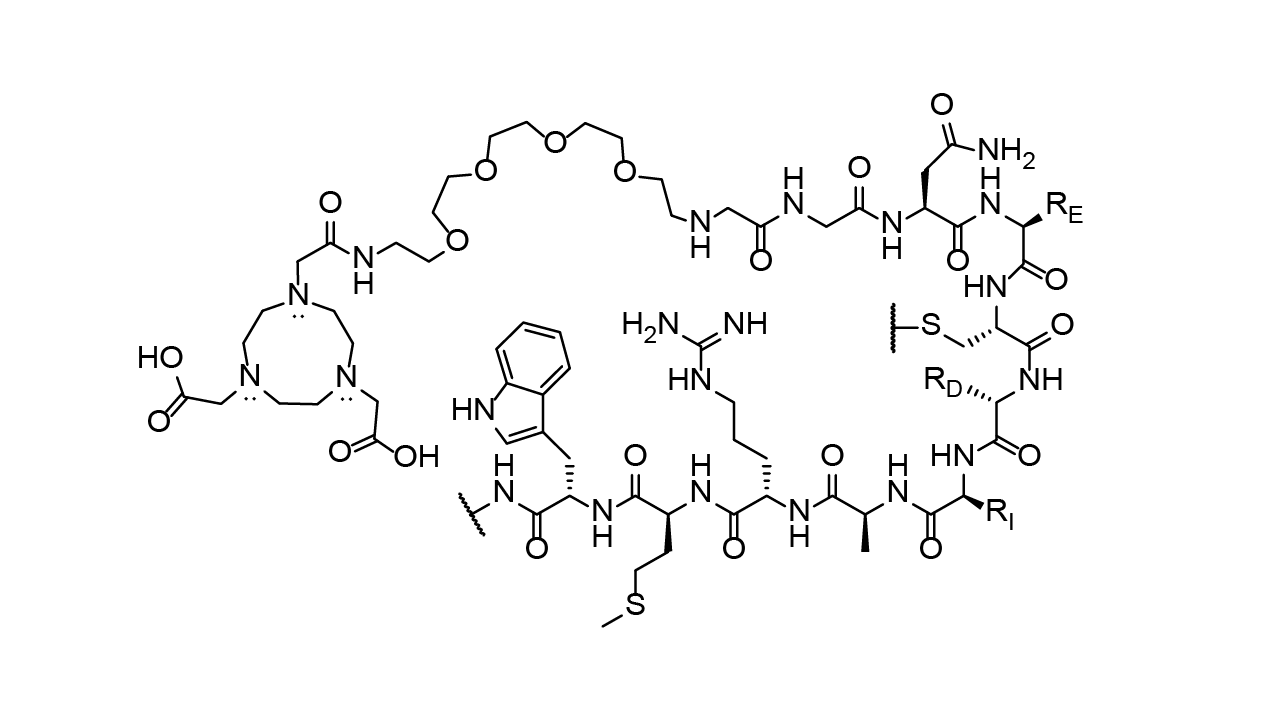
"L19K was synthesized by CPC Scientific and comprised the sequence NO2A-PEG4-GGNECDIARMWEWECFERK-CONH2, with Cys-Cys disulfide bridge and polyethylene glycol (PEG4) as a spacer between peptide and chelator. "
Abstract
Imaging agents based on peptide probes have desirable pharmacokinetic properties provided that they have high affinities for their target in vivo. An approach to improve a peptide ligand’s affinity for its target is to make this interaction covalent and irreversible. For this purpose, we evaluated a 64Cu-labeled affinity peptide tag, 64Cu-L19K-(5-fluoro-2,4-dinitrobenzene) (64Cu-L19K-FDNB), which binds covalently and irreversibly to vascular endothelial growth factor (VEGF) as a PET imaging agent. We compared the in vivo properties of 64Cu-L19K-FDNB in VEGF-expressing tumor xenografts with its noncovalent binding analogs, 64Cu-L19K-(2,4-dinitrophenyl) (64Cu-L19K-DNP) and 64Cu-L19K. Methods: The L19K peptide (GGNECDIARMWEWECFERK-CONH2) was constructed with 1,4,7-triazacyclononane-1,4,7-triacetic acid at the N terminus for radiolabeling with 64Cu with a polyethylene glycol spacer between peptide and chelate. 1,5-difluoro-2,4-dinitrobenzene was conjugated at the C-terminal lysine for cross-linking to VEGF, resulting in L19K-FDNB. 64Cu-L19K-FDNB was assayed for covalent binding to VEGF in vitro. As a control, L19K was conjugated to 1-fluoro-2,4-dinitrobenzene, resulting in L19K-DNP. PET imaging and biodistribution studies of 64Cu-L19K-FDNB, 64Cu-L19K-DNP, and the native 64Cu-L19K were compared in HCT-116 xenografts. Blocking studies of 64Cu-L19K-FDNB was performed with a coinjection of excess unlabeled L19K-FDNB. Results: In vitro binding studies confirmed the covalent and irreversible binding of 64Cu-L19K-FDNB to VEGF, whereas 64Cu-L19K-DNP and 64Cu-L19K did not bind covalently. PET imaging showed higher tumor uptake with 64Cu-L19K-FDNB than with 64Cu-L19K-DNP and 64Cu-L19K, with mean standardized uptake values of 0.62 ± 0.05, 0.18 ± 0.06, and 0.34 ± 0.14, respectively, at 24 h after injection (P < 0.05), and 0.53 ± 0.05, 0.32 ± 0.14, and 0.30 ± 0.09, respectively, at 48 h after injection (P < 0.05). Blocking studies with 64Cu-L19K-FDNB in the presence of excess unlabeled peptide showed a 53% reduction in tumor uptake at 48 h after injection. Conclusion: In this proof-of-concept study, the use of a covalent binding peptide ligand against VEGF improves tracer accumulation at the tumor site in vivo, compared with its noncovalent binding peptide analogs. This technique is a promising tool to enhance the potency of peptide probes as imaging agents.
SOCIAL MEDIA
Connect with us and stay updated by following our social media channels.
Latest Briefings from our Knowledge Center
Press Releases, Industry News, Articles, and Technical Content
Järveläinen, Harri A., Christian Schmithals, Maike von Harten, Bianca Kakoschky, Thomas J. Vogl, Stephen Harris, Claire Henson, Gemma Bullen-Clerkson, and Albrecht Piiper. International Journal of Molecular Sciences 24, no. 6 (2023): 5700.
The cyclic iRGD/CEND-1 peptide [sequence: CRGDKGPDC] and RGD control peptide (CRGDDGPKC) for pre-clinical use was sourced either from GenScript (Piscataway, NJ, USA) or CPC Scientific (Hangzhou, China).
Lin, Wilson, Eduardo Aluicio-Sarduy, Hailey A. Houson, Todd E. Barnhart, Volkan Tekin, Justin J. Jeffery, Ashley M. Weichmann, Kendall E. Barrett, Suzanne E. Lapi, and Jonathan W. Engle. Nuclear Medicine and Biology) 118 (2023): 108329.
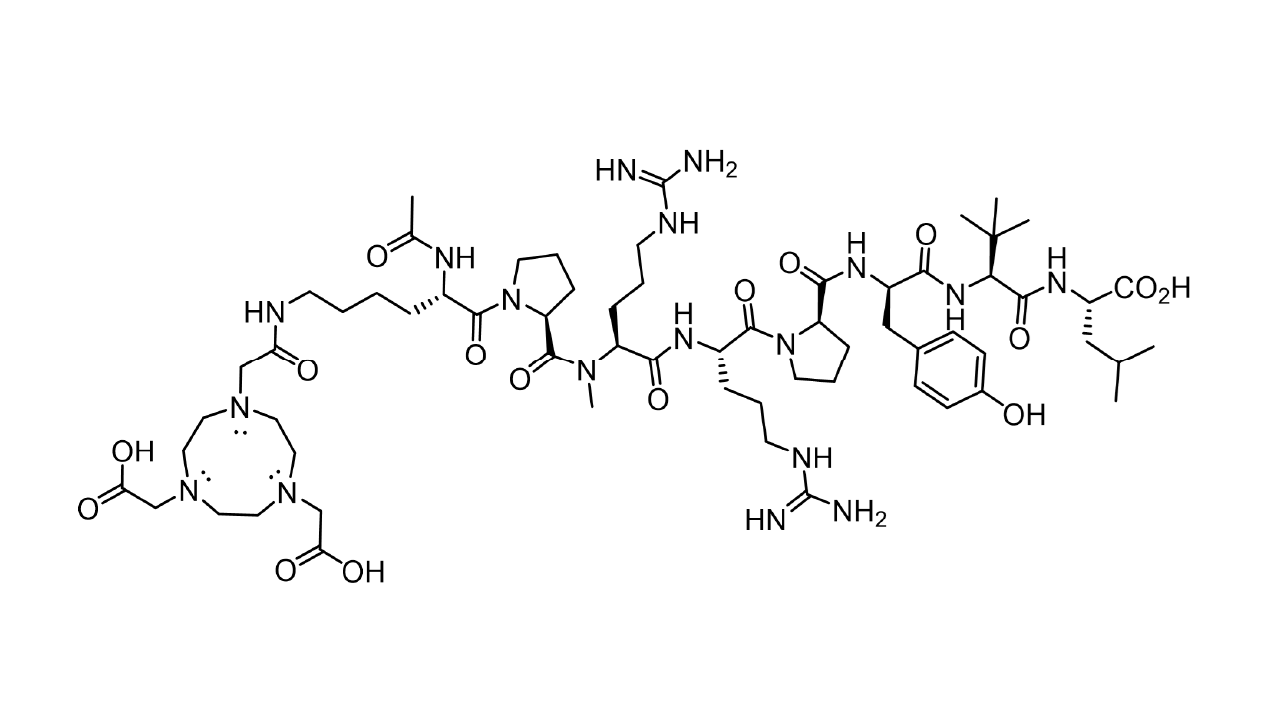
Lyophilized NOTA-NT-20.3 (Ac-Lys(NOTA)-Pro-NMeArg-Arg-Pro-Tyr-Tle-Leu, 1383.6 g/mol, “NT”, CPC Scientific) was diluted to 1 mg/mL in ultrapure water (Milli-Q, >18.2 MΩ-cm) and used without further purification.
Development of a selective, sensitive and robust oxyntomodulin dual monoclonal antibody immunoassay.
Umberger, T.S., Ming, W., Cox, J.M., Konrad, R.J. and Siegel, R.W. Bioanalysis 14, no. 18 (2022): 1229-1239.
- Lilly Research Laboratories, Eli Lilly & Company, Indianapolis, IN46285, USA
Human K2 EDTA and P800 plasma (500 μl) was spiked with proglucagon 33–61, 35–61 and 36–61 stable-isotope-labeled internal standard peptides (CPC Scientific, custom order) and diluted with I buffer (25 mmol/l Tris-HCl, 25 mmol/l HEPES, 300 mmol/l NaCl, 0.1% (v/v) octyl β-D-glucopyranoside, pH 7.5).
Line, J.E.; Seal, B.S.; Garrish, J.K. Appl. Microbiol. 2022, 2, 688–700.
Peptides were synthesized using standard solid-phase(Fmoc) chemistry with a peptide synthesizer (CPC Scientific Inc., Sunnyvale, CA 94089,USA, C12K-2β12 [..]
Kirk, N.S., Chen, Q., Wu, Y.G., Asante, A.L., Hu, H., Espinosa, J.F., Martínez-Olid, F., Margetts, M.B., Mohammed, F.A., Kiselyov, V.V. and Barrett, D.G. Nature Communications 13, no. 1 (2022): 5695.
- Eli Lilly and Company, Lilly Corporate Center, Indianapolis, IN 46285, USA.
Peptides were synthesized under contract by CPC Scientific, except for the N-terminally acetylated version of IM172N22 and the Glu3Arg, Glu3Ala, Glu4Arg, Glu4Ala, Glu5Ala, Glu5Arg, Trp6Ala, Gln8Ala, Ile9Ala, Glu10Ala, Glu10Arg and Tyr14Ala mutants of IM172N22
Coskun, T., Urva, S., Roell, W.C., Qu, H., Loghin, C., Moyers, J.S., O’Farrell, L.S., Briere, D.A., Sloop, K.W., Thomas, M.K. and Pirro, V. Cell Metabolism 34, no. 9 (2022): 1234-1247.
- Eli Lilly and Company, Lilly Corporate Center, Indianapolis, IN 46285, USA
Homologous and heterologous competition experiments were performed with non-radioactive peptide analogues[127I]-Tyr1-GIP(1-42) and [127]-Tyr10-GIP(1-42) to ensure quantification of the high-affinity binding site of the GIPR. Peptide analogues were generated using synthetic [127I]-Tyr amino acid building blocks (CPC Scientific).
Cecil, D.L., Curtis, B., Gad, E., Gormley, M., Timms, A.E., Corulli, L., Bos, R., Damle, R.N., Sepulveda, M.A. and Disis, M.L. Scientific Reports 12, no. 1 (2022): 13618.
- Cancer Vaccine Institute, University of Washington, 850 Republican Street, Brotman Bld., 2nd Floor, Box 358050, Seattle, WA 98195-8050, USA.
- Janssen Research and Development LLC, Spring House, PA, USA.
- Janssen Vaccines and Prevention, Leiden, The Netherlands.
The peptides were constructed and purified by high-performance liquid chromatography (> 90% pure; CPC Scientific).
Zonari, A., Brace, L.E., Alencar-Silva, T., Porto, W.F., Foyt, D., Guiang, M., Cruz, E.A.O., Franco, O.L., Oliveira, C.R., Boroni, M. and Carvalho, J.L. Toxicology Reports 9 (2022): 1632-1638.
Peptide 14 (ETAKHWLKGI) (Sup. Fig. 1) was purchased from CPC Scientific Inc. (USA), which synthesized the peptide by solid phase (Fmoc) on a Rink amide resin, with > 95% purity, in the form of acetate salt.