
Genomics research shows that more than a million proteins are encoded by approximately 30,000 human genes. Proteomics, the study of proteins encoded by the genome, includes identification of post-translational modifications, structural analyses, protein localization studies, and protein quantitation. Mass spectroscopy-based techniques have evolved as a powerful tool in proteomics. Stable isotope-labeled peptides (SIL peptides) are chemically and physically indistinguishable from their endogenous counterparts with respect to retention time, ionization efficiency, and fragmentation pathways. Therefore, either are ideal internal standards and template analytes. Peptides can be labeled with one or more isotopes of hydrogen, carbon, nitrogen, or oxygen by incorporating amino acids containing the desired isotopes such as deuterium (D), 13C, 15N, or 18O into the peptide during synthesis.
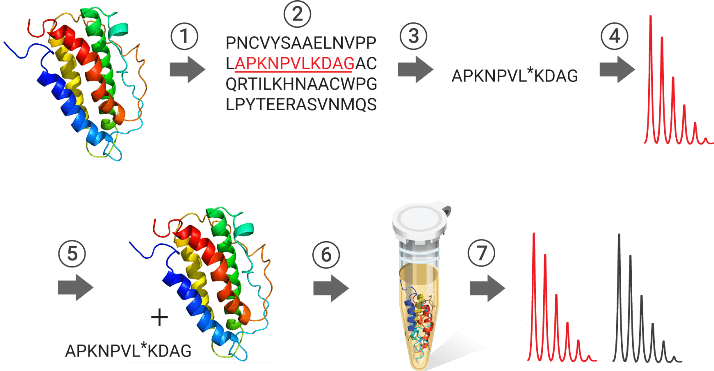
The Absolute Quantification method (AQUA) enables targeted quantification of protein and post-translational modifications in complex protein mixtures using SIL peptides as internal standards. The SIL peptide is introduced into a biological sample during or after protease digestion. The heavy SIL peptide and its light endogenous peptide fragment are detected by selected reaction monitoring (SRM) in a mass spectrometer. Based on the known amount of SIL peptide added, and the intensity ratio of both peptides, the amount of endogenous protein can be calculated.
Isotopic Labeling Chemistry
Isotopic Amino Acid Table
| AMINO ACID | ISOTOPE | MASS DIFFERENCE | ISOTOPIC ENRICHMENT |
|---|---|---|---|
| Alanine | 13C3, 15N | 4 | >99% |
| Arginine | 13C6, 15N4 | 10 | >99% |
| Isoleucine | 13C6, 15N | 7 | >99% |
| Leucine | 13C6, 15N | 7 | >99% |
| Lysine | 13C6, 15N2 | 8 | >99% |
| Phenylalanine | 13C9, 15N | 10 | >99% |
| Proline | 13C5, 15N | 6 | >99% |
| Valine | 13C5, 15N | 6 | >99% |
SIL Peptides in Structural Analysis
Nuclear Magnetic Resonance (NMR) is a powerful technique for investigating structural information, dynamics, and molecular interactions of biomolecules. This technique can be used to measure relaxation rates of biomolecules as they dissociate from their bound target. Peptides labeled with D (spin of 1), 13C (spin 1/2), and 15N (spin 1/2) are suitable for NMR studies of proteins. A combination of NMR spectroscopy and segmental isotopic labeling is used to study the mechanism of protein splicing (e.g., the structure of an active protein splicing precursor), a post-translational autocatalytic process in which an intervening sequence, termed an intein, is removed from a host protein, the extein.
High Quality SIL Peptides from CPC Scientific
Absolute quantitation of a complex protein mixture at very low concentrations and structural studies requires high-quality peptides enriched with stable isotopes. The CPC Scientific SIL Peptide Custom Synthesis Service guarantees superior quality and high isotopic enrichment. These stable isotopic peptides are synthesized using the latest Fmoc solid-phase peptide technology in our state-of-the-art peptide laboratory. All heavy isotope-labeled peptides undergo mass spectrometric analysis and stringent analytical HPLC to establish the final purity and assure that our customers receive only the highest quality peptides for absolute quantitation and other studies.
Two major isotopes, 15N and 13C, are incorporated into a specific amino acid sequence of peptides. Each atom contains over 99% of an enriched isotope and can be located at multiple positions within the peptide. For example, a Leu amino acid containing one 15N and six 13C, and a peptide containing one such isotope-labeled Leu amino acid, has seven units of molecular weight higher than the corresponding unlabeled peptide.
SIL Peptide Applications
- Functional quantitative proteomics
- Quantitation of post translationally-modified proteins
- Protein structure analysis
- Protein expression monitoring
- Biomarker discovery
- Pharmacokinetics
- Metabolomics
- Clinical biochemistry for drug and metabolite monitoring
- Anti-doping testing
- Cell signal profiling and pathway validation
- Protein cross-linking analysis
SIL Peptide Modifications
- Phospho-Tyr, Ser, Thr (single or multiple)
- Sulfo-Tyr (single or multiple)
- Methylated Arg, Lys
- Chloro-Tyr
- Met-oxidized
- Pyroglutamic acid
The Absolute Quantification method (AQUA) enables targeted quantification of protein and post-translational modifications in complex protein mixtures using SIL peptides as internal standards. The SIL peptide is introduced into a biological sample during or after protease digestion. The heavy SIL peptide and its light endogenous peptide fragment are detected by selected reaction monitoring (SRM) in a mass spectrometer. Based on the known amount of SIL peptide added, and the intensity ratio of both peptides, the amount of endogenous protein can be calculated.
Isotope-Labeled Peptide Citations
Harper, Brett, Mahsan Miladi, and Touradj Solouki. Journal of The American Society for Mass Spectrometry 25.10 (2014): 1716-1729.
"antipeptide (EGVYVHPV), angiotensin II, human (DRVYIHPF), and isotopically (13C) labeled heptapeptide (AAAAHAA-NH2 [where “A” indicates a carbon thirteen (13C) isotope on the alanine carbonyl group]) were purchased from CPC Scientific Incorporated (Sunnyvale, CA)"
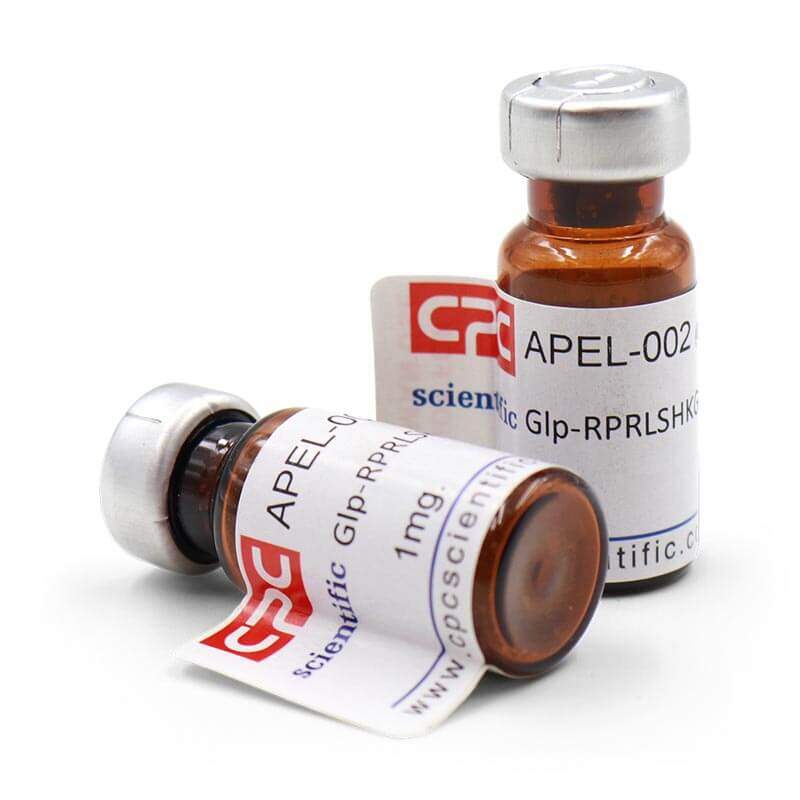
Zhen, Eugene Y., Richard E. Higgs, and Jesus A. Gutierrez. Analytical Biochemistry 442.1 (2013): 1-9.
"Both the stable isotope-labeled (SIL) and unlabeled apelin peptides [apelin-36, apelin-17, apelin-13, (pyr)apelin-13, and apelin-12] were synthesized by CPC Scientific (Sunnyvale, CA, USA)."
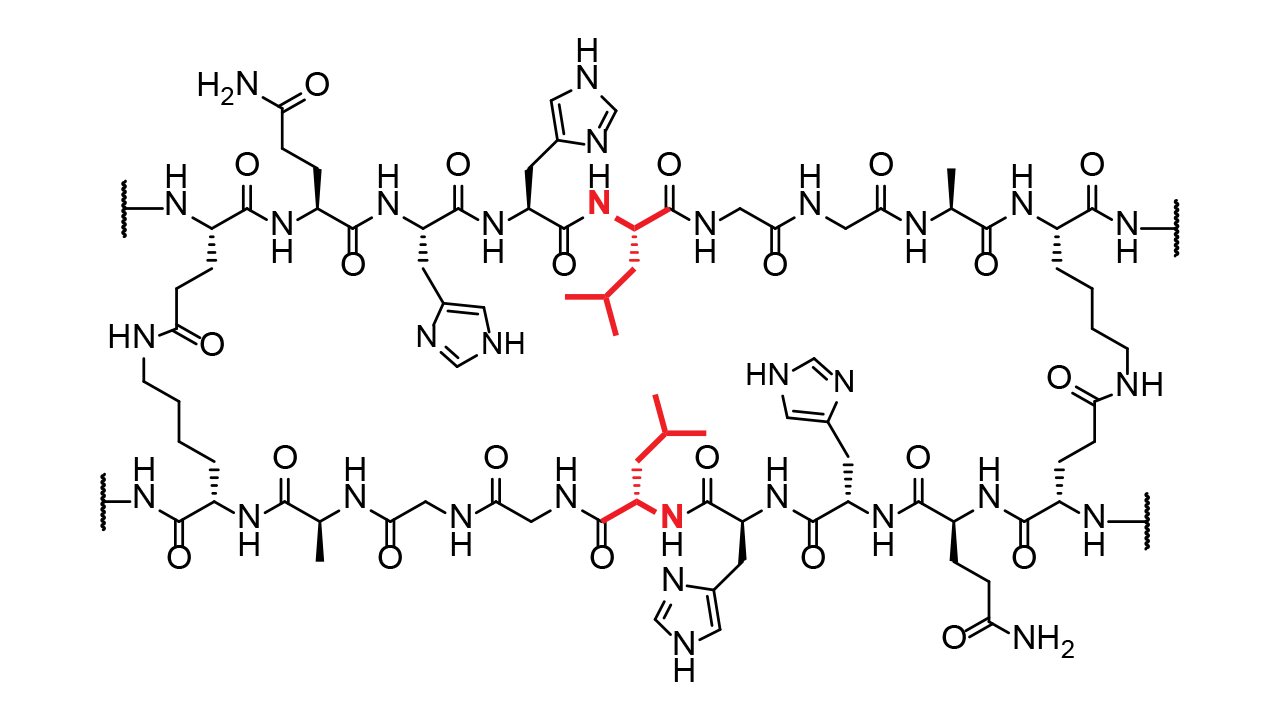
Wang, W., Walker, N.D., Zhu, L.J., Wu, W., Ge, L., Gutstein, D.E., Yates, N.A., Hendrickson, R.C., Ogletree, M.L., Cleary, M. and Opiteck. Analytical Chemistry 84.15 (2012): 6891-6898.
- Departments of Molecular Biomarkers, Cardiovascular Diseases, and Clinical Pharmacology, Merck Research Laboratories, Rahway, New Jersey, United States.
"Peptide Stable isotope–labeled internal standard peptide (Q 7 and K 15 reciprocally cross-linked dimer of LTIGEGQQHHL*GGAKQAGDV, where L* represents 13 C 6 , 15 N 1 -labeled leucine) was synthesized and analyzed for purity and amino acid content (CPC Scientific)"
Havukainen, Heli, et al. The Journal of Experimental Biology 215.11 (2012): 1837-1846.
"[..] polyserine tract of AmVg and NvVg were synthesized by CPC Scientific (Sunnyvale, CA, USA) for NMR analysis. The synthesis was performed after isotope-labeling expression attempts in Escherichia coli were deemed unsuitable [..] The peptides had the following sequences: AmVg (residues 358–392): EKLKQDILNLRTDISTS(Sp)SS(15I)SSSEENDFWQPKPT AmVg (residues 336–385): R(15V)SKT(15A)MNSNQI(15V)SDNS(15L)-(15S)STEEK(15L)KQDI(15L)N(15L)RTDI(15S)S(15S)(Sp)S(15A)IS (15S)(15S)EEND. NvVg (residues 351–385): EHKHSDESTSE(Sp)FES(15I)ADNNDDSYFQRKPKLTEAP." NvVg (residues 335–372): RPNK(15L)N(15L)QRRHDHKS(15G)EHKHSDE(15S)S-(15S)E(Sp)FE(15A)I(15A)DNNDD.