
"[..] polyserine tract of AmVg and NvVg were synthesized by CPC Scientific (Sunnyvale, CA, USA) for NMR analysis. The synthesis was performed after isotope-labeling expression attempts in Escherichia coli were deemed unsuitable [..] The peptides had the following sequences: AmVg (residues 358–392): EKLKQDILNLRTDISTS(Sp)SS(15I)SSSEENDFWQPKPT AmVg (residues 336–385): R(15V)SKT(15A)MNSNQI(15V)SDNS(15L)-(15S)STEEK(15L)KQDI(15L)N(15L)RTDI(15S)S(15S)(Sp)S(15A)IS (15S)(15S)EEND. NvVg (residues 351–385): EHKHSDESTSE(Sp)FES(15I)ADNNDDSYFQRKPKLTEAP." NvVg (residues 335–372): RPNK(15L)N(15L)QRRHDHKS(15G)EHKHSDE(15S)S-(15S)E(Sp)FE(15A)I(15A)DNNDD.
Abstract
Vitellogenin (Vg) is an egg-yolk precursor protein in most oviparous species. In honeybee (Apis mellifera), the protein (AmVg) also affects social behavior and life-span plasticity. Despite its manifold functions, the AmVg molecule remains poorly understood. The subject of our structure-oriented AmVg study is its polyserine tract — a little-investigated repetitive protein segment mostly found in insects. We previously reported that AmVg is tissue specifically cleaved in the vicinity of this tract. Here, we show that, despite its potential for an open, disordered structure, AmVg is unexpectedly resistant to trypsin/chymotrypsin digestion at the tract. Our findings suggest that multiple phosphorylation plays a role in this resilience. Sequence variation is highly pronounced at the polyserine region in insect Vgs. We demonstrate that sequence differences in this region can lead to structural variation, as NMR and circular dichroism (CD) evidence assign different conformational propensities to polyserine peptides from the honeybee and the jewel wasp Nasonia vitripennis; the former is extended and disordered and the latter more compact and helical. CD analysis of the polyserine region of bumblebee Bombus ignitus and wasp Pimpla nipponica supports a random coil structure in these species. The spectroscopic results strengthen our model of the AmVg polyserine tract as a flexible domain linker shielded by phosphorylation.
SOCIAL MEDIA
Connect with us and stay updated by following our social media channels.
Latest Briefings from our Knowledge Center
Press Releases, Industry News, Articles, and Technical Content
2020 has been a challenging year for all of us. We have experienced firsthand how a global pandemic has changed the world we live in. In spite of this, we’ve seen people and business coming together to make a difference. CPC Scientific’s mission is to collaborate with our customers to improve the quality of […]
DePalma, S. J.; Davidson, C. D.; Stis, A. E.; Helms, A. S.; Baker, B. M., Biomaterials Science, 2021, 9 (1), 93-107.
.. matrices were functionalized with cell adhesive peptides.. Gly-Phe-Hyp-Gly-Glu-Arg (GFOGER; CPC Scientific) via Michael-Type addition to available vinyl sulfone groups."
Zonari, A.; Brace, L. E.; Al-Katib, K. Z.; Porto, W. F.; Foyt, D.; Guiang, M.; Cruz, E. A. O.; Marshall, B.; Salgueiro, W. G.; Inan, M. D., bioRxiv 2020, 2020.10. 30.362822.
The top hits peptides selected (peptide 14, 144, 156, 195, and 393) from the screening were purchased from CPC Scientific Inc.
Diao, J., Komura, R., Sano, T., Pantua, H., Storek, K.M., Inaba, H., Ogawa, H., Noland, C.L., Peng, Y., Gloor, S.L. and Yan, D. bioRxiv (2020): 2020-10.
- Departments of Infectious Diseases, Structural Biology, Biochemical and Cellular Pharmacology, Translational Immunology, Pathology, and Early Discovery Biochemistry, Genentech, South San Francisco, CA 94080 USA
The standard assay consists of 6 μL reaction mixture with 3 nM Lgt-DDM, 50 μM phosphatidylglycerol (1,2-dipalmitoyl-sn-glycero-3-phospho-(1’-rac-glycerol), Avanti), 12.5 μM Pal-IAAC peptide substrate derived from the Pal lipoprotein (MQLNKVLKGLMIALPVMAIAACSSNKN, synthesized by CPC Scientific)
Pantua, H., Skippington, E., Braun, M.G., Noland, C.L., Diao, J., Peng, Y., Gloor, S.L., Yan, D., Kang, J., Katakam, A.K. and Reeder, J. MBio 11, no. 5 (2020): 10-1128.
- Departments of Infectious Diseases, OMNI Bioinformatics, Chemistry, Structural Biology, Biochemical and Cellular Pharmacology, Translational Immunology, Pathology, Molecular Biology, Genentech, South San Francisco, California, USA
MQLNKV-L(U13C6,15N)-KGL(U13C6,15N)MIALPVMAIAA-dipalmitoyl2C-SSNKNGG-K-biotin, which upon cleavage by LspA, yields the product peptide dipalmitoyl2C-SSNKNGG-K-biotin. A product standard [dipalmitoyl2C-SSNKNAAK-(NHCH2CH2NH)-biotin; CPC Scientific] was in the reaction mixture as an internal standard for normalization of product quantitation.
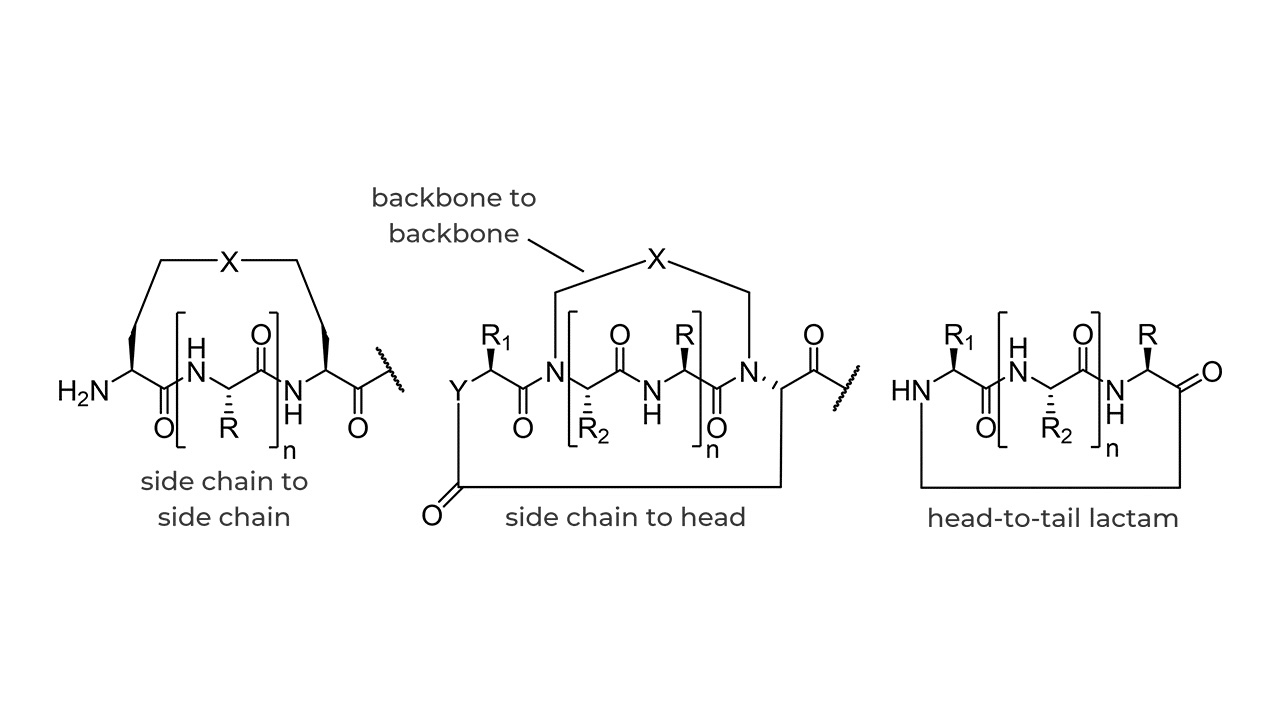
Protein-protein and protein-peptide interactions play critical roles in all types of cellular processing. Peptides are natural partners to proteins and, as ligands, bind to proteins with high affinity due to their capacity to adapt to the often flexible protein surface. Despite this, peptides have drawbacks as drug candidates that include low plasma bioavailability, instability from proteolytic enzymes, and poor passive membrane permeability. Some success has been achieved with linear peptides, particularly peptides that maintain α-helical secondary structures. These motifs can be introduced to stabilized α-helical motifs by common “peptide-stapling” approaches, but stapled peptides can suffer from low bioactivity and poor solubility. Another strategy to maintain peptide secondary structure is modification by macrocyclization.
SAN JOSE, CA., Sept 3, 2020 /CPCNewswire/ — CPC Scientific Inc. is pleased to announce that the European Commission (EC) has granted the Conditional Marketing Authorization (CMA) for MYR Pharmaceuticals lead compound HEPCLUDEX®. CPC Scientific serves as a supplier and partner to MYR Pharmaceuticals for the development and manufacturing of bulevirtide (Hepcludex). This drug is […]
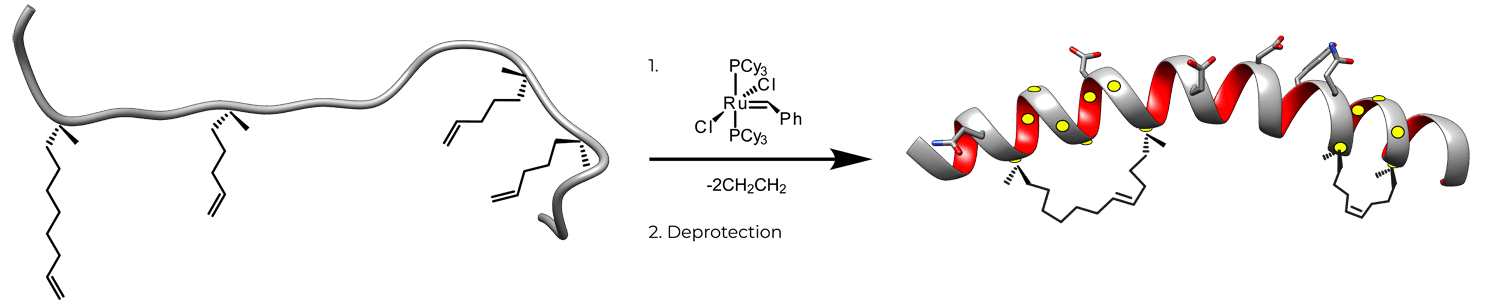
Curreli, Francesca, Sofia MB Victor, Shahad Ahmed, Aleksandra Drelich, Xiaohe Tong, Chien-Te K. Tseng, Christopher D. Hillyer, and Asim K. Debnath. Mbio 11, no. 6 (2020): e02451-20.
We have synthesized (CPC Scientific, Inc.) four stapled peptides, as depicted in Figure 2. We also synthesized the linear peptide, NYBSP-C, as a control. Besides, we purchased a linear peptide, SBP1, to use as a control, which was reported recently to bind to SARS-CoV-2 RBD with high affinity (KD = 47nM).