
"[..] polyserine tract of AmVg and NvVg were synthesized by CPC Scientific (Sunnyvale, CA, USA) for NMR analysis. The synthesis was performed after isotope-labeling expression attempts in Escherichia coli were deemed unsuitable [..] The peptides had the following sequences: AmVg (residues 358–392): EKLKQDILNLRTDISTS(Sp)SS(15I)SSSEENDFWQPKPT AmVg (residues 336–385): R(15V)SKT(15A)MNSNQI(15V)SDNS(15L)-(15S)STEEK(15L)KQDI(15L)N(15L)RTDI(15S)S(15S)(Sp)S(15A)IS (15S)(15S)EEND. NvVg (residues 351–385): EHKHSDESTSE(Sp)FES(15I)ADNNDDSYFQRKPKLTEAP." NvVg (residues 335–372): RPNK(15L)N(15L)QRRHDHKS(15G)EHKHSDE(15S)S-(15S)E(Sp)FE(15A)I(15A)DNNDD.
Abstract
Vitellogenin (Vg) is an egg-yolk precursor protein in most oviparous species. In honeybee (Apis mellifera), the protein (AmVg) also affects social behavior and life-span plasticity. Despite its manifold functions, the AmVg molecule remains poorly understood. The subject of our structure-oriented AmVg study is its polyserine tract — a little-investigated repetitive protein segment mostly found in insects. We previously reported that AmVg is tissue specifically cleaved in the vicinity of this tract. Here, we show that, despite its potential for an open, disordered structure, AmVg is unexpectedly resistant to trypsin/chymotrypsin digestion at the tract. Our findings suggest that multiple phosphorylation plays a role in this resilience. Sequence variation is highly pronounced at the polyserine region in insect Vgs. We demonstrate that sequence differences in this region can lead to structural variation, as NMR and circular dichroism (CD) evidence assign different conformational propensities to polyserine peptides from the honeybee and the jewel wasp Nasonia vitripennis; the former is extended and disordered and the latter more compact and helical. CD analysis of the polyserine region of bumblebee Bombus ignitus and wasp Pimpla nipponica supports a random coil structure in these species. The spectroscopic results strengthen our model of the AmVg polyserine tract as a flexible domain linker shielded by phosphorylation.
SOCIAL MEDIA
Connect with us and stay updated by following our social media channels.
Latest Briefings from our Knowledge Center
Press Releases, Industry News, Articles, and Technical Content
Baba, Osamu, Andrew Elvington, Martyna Szpakowska, Deborah Sultan, Gyu Seong Heo, Xiaohui Zhang, Hannah Luehmann et al. bioRxiv (2020).
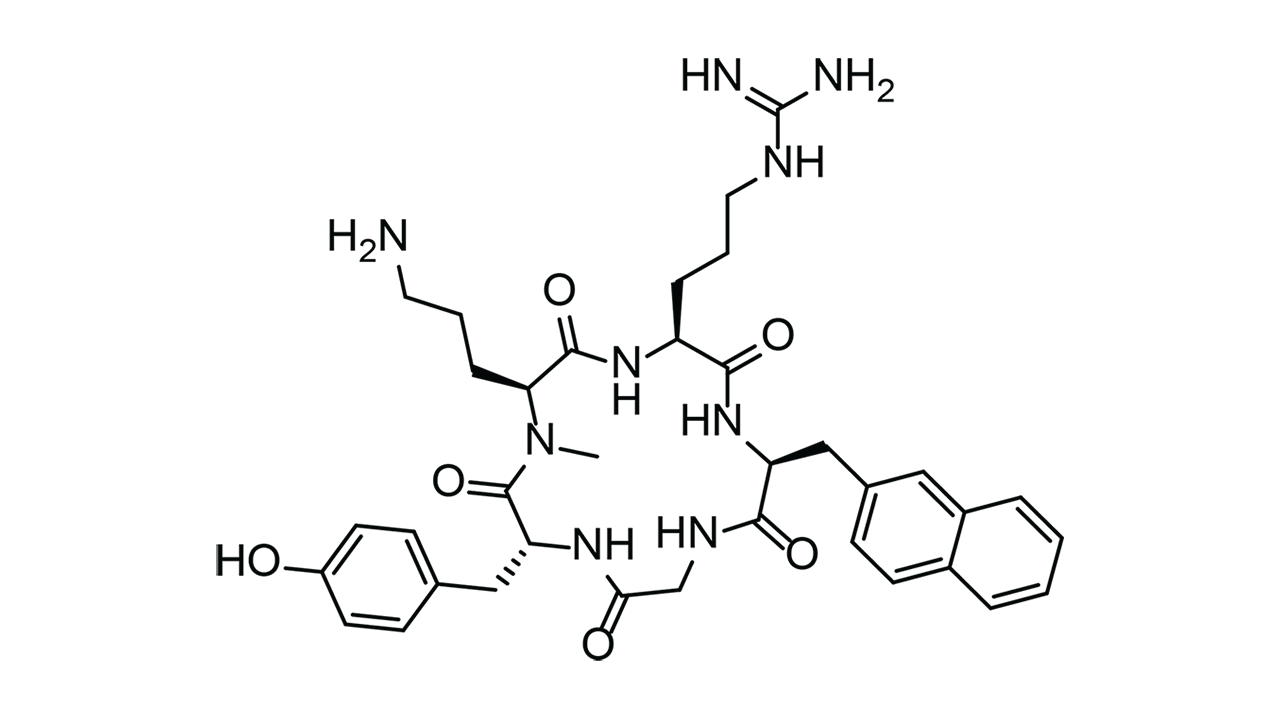
The FC131 peptide (cyclo[2-Nal-Gly-d-Tyr-NMe-d-Orn-Arg]) was synthesized by CPC Scientific (Sunnyvale, CA).
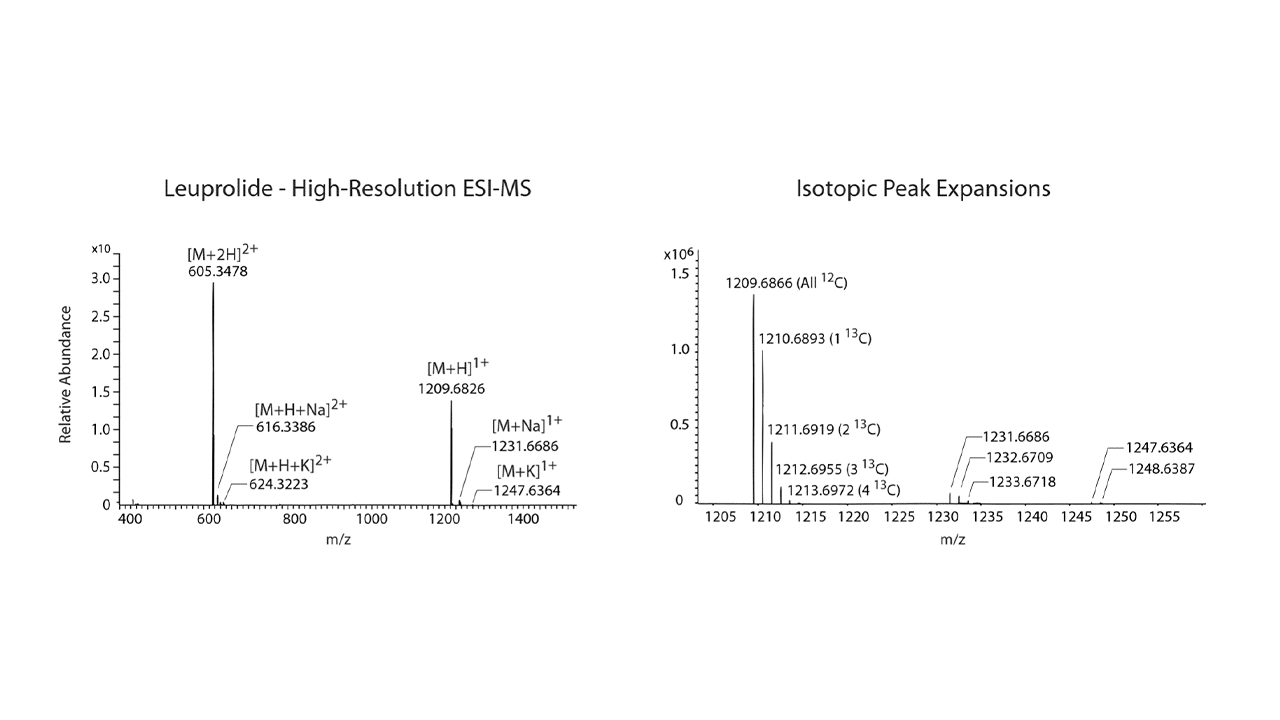
This guide will help you understand how to read ESI spectra for large and complex bio-molecules like peptides. Other techniques such as high-performance liquid chromatography (HPLC) show one major peak (i.e., absorbance and purity for RP-HPLC) in the spectra, making the interpretation straightforward. ESI-MS spectra are more complicated due to the multiplicity of the data. While most small molecules (100-500 AMU) behave well in ESI-MS and ionize as a single charged state, larger biomolecules, such as peptides, ionize as multiple charged variants. A major advantage of ESI-MS over other mass spectroscopy techniques is that molecular fragmentation is rare (t-Boc groups and a few other protection groups are an exception), which is why ESI-MS is often referred to as a soft ionization technique.
Vickers, Timothy A., Meghdad Rahdar, Thazha P. Prakash, and Stanley T. Crooke. Nucleic Acids Research (2019).
A solution of 1.5 umol SmBiT peptide (Val-Thr-Gly-Tyr-Arg-Leu-Phe-Glu-Glu-Ile-Leu-Gly-Gly-Ser-Gly-Gly-Lys(N3)-NH2) containing an azide group at the C-terminus (CPC Scientific, 1245 Reamwood Ave, Sunnyvale, CA, USA) in DMSO (0.5 ml) was added and the reaction mixture was stirred at room temperature for 5 h.
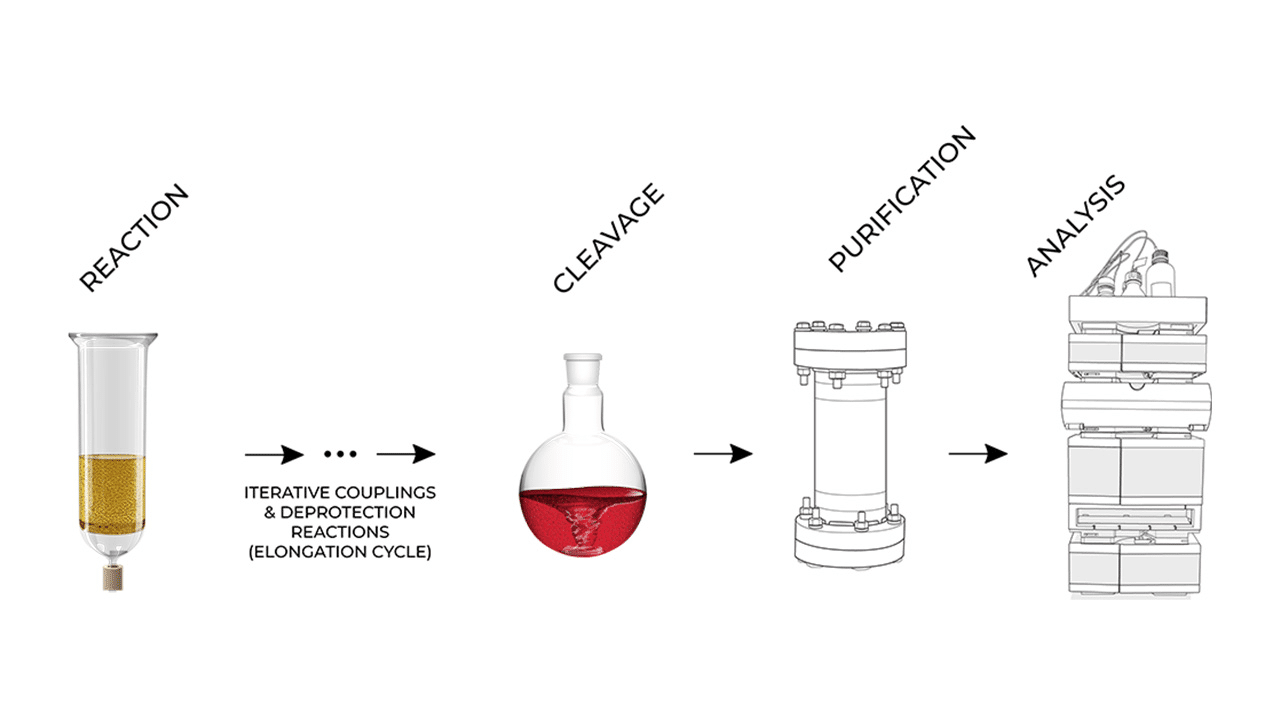
Solid-phase peptide synthesis (SPPS) has many advantages over liquid-phase peptide synthesis (LPPS) for preparing and manufacturing synthetic peptides. Except the synthesis of short peptide sequences (i.e., less than five amino acid residues), SPPS is faster, more efficient, and more economical than liquid-phase peptide synthesis (LPPS). Some of the advantages of SPPS include: (1) Excess reagents and products can be easily washed away, (2) using excess reagents to increase reaction rates and drive reactions to completion, (3) intermediates do not require isolation or characterization, (4) access to a broader range of solvents with low volatility and high polarity, (5) tethered peptide provides a ‘pseudo-dilute’ microenvironment, which can inhibit intermolecular reactions, making some modifications easier to accomplish, and (6) compatibility with automated synthesis technology.
Lo, J.H., Hao, L., Muzumdar, M.D., Raghavan, S., Kwon, E.J., Pulver, E.M., Hsu, F., Aguirre, A.J., Wolpin, B.M., Fuchs, C.S. and Hahn, W.C. Molecular Cancer Therapeutics 17, no. 11 (2018): 2377-2388.
pTP-TAMRA-iRGD (CH3(CH)15-[GWTLNSAGYLLGKINLKALAALAKKIL-GGK(TAMRA)GGCRGDKGPDC, Cys-Cys bridge]) used in all figures except Fig. S1 was synthesized by CPC Scientific.
Ng, Ee Xien, Myat Noe Hsu, Guoyun Sun, and Chia-Hung Chen. Methods in Enzymology 628 (2019): 59-94.
The peptide sequences of the four FRET-based substrates ([..] CPC Scientific) are as follows: UV: AlexaFluor405-Leu-Ala-Gln-Ala-HompheArg-Ser-Lys (QSY35)-NH2; Blue: Dabcyl-Gly-Pro-Leu-Gly-Met-Arg-Gly-Lys (5-FAM)-NH2; Green: QSY7-Ala-Pro-Phe-Glu..
West, J.A., Tsakmaki, A., Huang, J.H., Ghosh, S.S., Parkes, D.G., Wismann, P., Rigbolt, K.T., Pedersen, P.J., Pavlidis, P., Maggs, D. and Lopez-Talavera, J.C. bioRxiv (2019) 822122.
- Fractyl Laboratories Inc, Lexington, MA, 02421, USA
- Diabetes Research Group, School of Life Course Sciences, Faculty of Life Science and Medicine, King’s College London, London, WC2R 2LS, England, UK
[..] infusion of vehicle 2 via osmotic minipump; (2) glucagon-like peptide-1 receptor (GLP-1R) agonist (0.2 mg/kg liraglutide, SC, QD, Victoza (Novo Nordisk, Bagsværd, Denmark) and continuous infusion of vehicle 2 via osmotic minipump; (3) vehicle 1 (SC, QD) and continuous infusion of a glucose-dependent insulinotropic polypeptide receptor (GIPR) antagonist (∼4.5 mg/kg/day / 56.8 nmol/kg/h GIP[3-30]NH2, CPC Scientific Inc, Sunnyvale, CA, USA) via osmotic minipump;
Artur Javmen, Vladimir Y. Toshchakov, et al. Journal of Leukocyte Biology (2019).
All CPDPs included the N‐terminal Antennapedia homeodomain sequence RQIKIWFQNRRMKWKK.38 The Cy3‐labeled peptides were produced by CPC Scientific (Sunnyvale, CA, USA). The Cy3 label was placed at the peptide N‐terminus..
Gilles, Maud-Emmanuelle, Slack, Frank J, et al. Oncotarget, 2019, Vol. 10, (No. 51), pp: 5349-5358
"Tandem peptide (pTP-iRGD: CH3(CH)15-GWTLNSAGYLLGKINLKALAALAKKIL-GGK(TAMRA)GGCRGDKGPDC, Cys-Cys bridge) was synthesized by CPC Scientific."