
PRRT Manufacturing Case Study Presentation at Biologics 2024
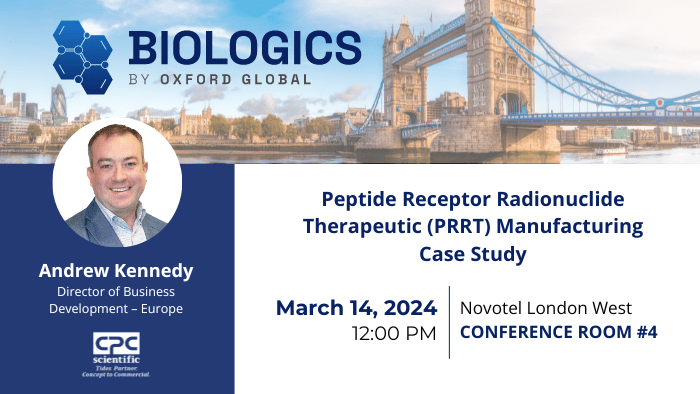
Schedule: March 14, 2024
Location: Novotel London West, London, W6 8DR
Join Andrew Kennedy, Ph.D.Director of Business Development – Europe for his presentation on the optimization and manufacturing process of DOTAGA-Labeled Urea-Based Peptide PSMA Inhibitor.
Peptide receptor radionuclide therapy (PRRT) is a targeted therapeutic strategy that uses peptides to deliver cytotoxic radiation levels to specific receptors overexpressed in cancer cells. Peptides are advantageous as therapeutic vectors in PRRT due to their small size, favorable pharmacokinetics, high binding affinity, low immunogenicity and toxicity, and minimal off-target binding. Tumor-targeting peptides conjugated to a radionuclide chelate constitute a new and powerful class of cancer medicines. Somatostatin, cytokine (e.g., IL-13Ra2), and integrins receptors, as well as vascular endothelial growth factor (VEGF), programmed death-ligand 1 (PD-L1), and prostate-specific membrane antigen (PSMA), have emerged as key targets for peptide radionuclide therapeutics. PSMA is an attractive target for prostate cancer because it’s overexpressed 100- to 1000-fold higher compared to normal tissue, is present during all stages of the disease, and its transmembrane conformation enables internalization of the therapeutic. This case study presents a manufacturing process for DOTAGA-Labeled urea-based peptide PSMA inhibitor API, DOTAGA-(I-y)fk(Sub-KuE). In only ten months, process development and GMP manufacturing were accomplished on a multigram scale. Process and analytical method development were carried out concurrently in the first three months, followed by a pilot batch (13g, one month), a toxicology study batch (29g, one month), and GMP production (45g, two months). Optimization of the synthesis, cleavage, and purification steps ensures a high crude yield (85-90% purity) and an overall yield of > 65% (> 98% purity). Developing an effective, validated HPLC method to remove chiral isomer impurities affords easy resolution and isolation of the final product.
Appointment Request
We would love to meet with you to discuss your peptide or oligonucleotide API project. Please visit us at Booth #53! or request to schedule an appointment using the form below.